

Updated Nov 23, 2026
How to Fix a Downspout That Drains in the Wrong Place
Redirect a badly placed downspout from the ground with an extension or splash block, and learn when moving it is a job for a gutter company.
You can fix most badly placed downspouts from the ground. Turn the lower elbow, add an extension, and send the water to a spot that slopes away from the house. Moving the downspout to a new place on the gutter means cutting a new outlet overhead, so hire a gutter company for that.
Looking for more guidance? Take a look at our Repairs overview.
The Department of Energy's Building America guide recommends discharging at least 5 feet from the foundation. The University of Minnesota Extension suggests at least 4 feet. Aim for 5 or more if you have the room.
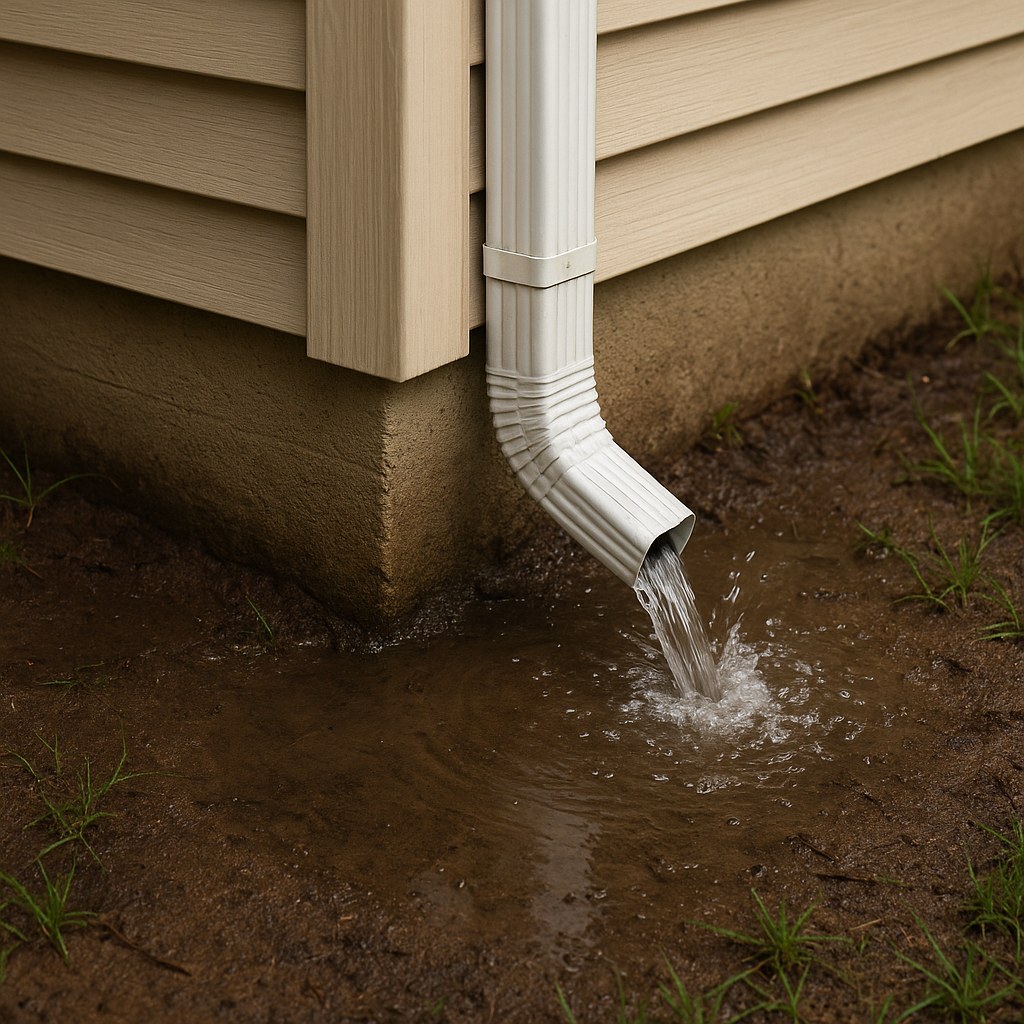
Why Proper Downspout Positioning Is Critical for Your Home
- Foundation damage. Saturated soil presses on foundation walls, which can crack or shift over time.
- Wet basement or crawl space. Water follows the wall down and finds any gap, then mold follows the water.
- Siding and paint damage. Splashback stains siding, peels paint, and rots wood trim near the ground.
- Washed-out beds. A strong stream digs out mulch, soil, and plants.
- Slippery walks. Water across a path or driveway grows algae in summer and ice in winter.
Signs a Downspout Is in the Wrong Place
- A puddle or a trench beside the house after rain
- Damp spots or white, chalky marks on the basement wall behind it
- Water spilling over the gutter at the end farthest from the downspout
- An elbow pointing at the wall, a window well, a walkway, or a neighbor
- A long stretch of gutter with only one downspout
Water pouring over the gutter is not always about position. If the gutter is clogged or sloped wrong, start with our guide to standing water in gutters.
Choose the Fix
| Problem | Fix | Who |
|---|---|---|
| Water lands beside the foundation | Add an extension | You |
| Water points at the wall, walk, or drive | Turn or replace the lower elbow | You |
| Water digs a hole in the bed | Add a splash block on sloped soil | You |
| The extension blocks a path | Hinged or roll-up extension, or a buried drain | You, or a drainage contractor |
| The pipe is loose from the wall up high | Refasten it | Gutter company |
| The outlet is at the wrong end of the gutter | Move the outlet and downspout | Gutter company |
| Gutter overflows even when clean | Add a downspout or correct the slope | Gutter company |
Getting Started: Tools and Materials
You need work gloves, safety glasses, a nut driver or screwdriver, a tape measure, short zip screws, and a garden hose for testing. A hacksaw or tin snips will trim a metal extension.
Measure the pipe before you shop. Rectangular downspouts are usually 2 by 3 or 3 by 4 inches, and round ones 3 or 4 inches across. Elbows come in two styles. An A elbow bends toward the wide face of the pipe, and a B elbow bends toward the narrow side. Take a photo and the old part to the store.
| Extension | Good for | Watch for |
|---|---|---|
| Straight metal or vinyl pipe | A permanent spot out of the way | Mowers and feet |
| Hinged, flips up | Lawns you mow | Putting it back down |
| Roll-out sleeve | Tight spots, no tripping when dry | Clogs, freezing, tearing |
| Flexible ribbed pipe | Bends around plants | Ridges trap leaves |
| Splash block | Soil that already slopes away | Too short on flat ground |
Step 1: Assess the Alignment
- Watch it in the rain. Find where the water lands and where it goes next.
- From the ground, look up at the top. The pipe should sit straight below the gutter outlet, with no gap at the joint and no water running down the outside.
- Check that the pipe runs straight down the wall and the straps hold it.
- Pick a discharge point on your own property that slopes away from the house. Do not send water onto a walkway, a neighbor's lot, or a septic field.
Step 2: Redirect It From the Ground
- Put on gloves and eye protection. Cut metal edges are sharp.
- Loosen the screws on the lowest elbow only, at ground level. Support the pipe so it does not drop.
- Turn the elbow, or slide on an extension that matches its size and shape.
- Fasten it with short screws. Keep the screws out of the main flow path where you can, because they catch leaves.
- Give the extension a slight downhill run. Building America suggests about 5/8 inch of fall per foot.
- Set a splash block or a patch of stone at the end.
- Run a hose into the extension, or wait for rain. Check for puddles along the wall.
Check the soil too. The Extension recommends ground that falls at least 1 inch per foot for the first 6 feet. If the soil slopes toward the house, an extension alone will not keep the area dry.
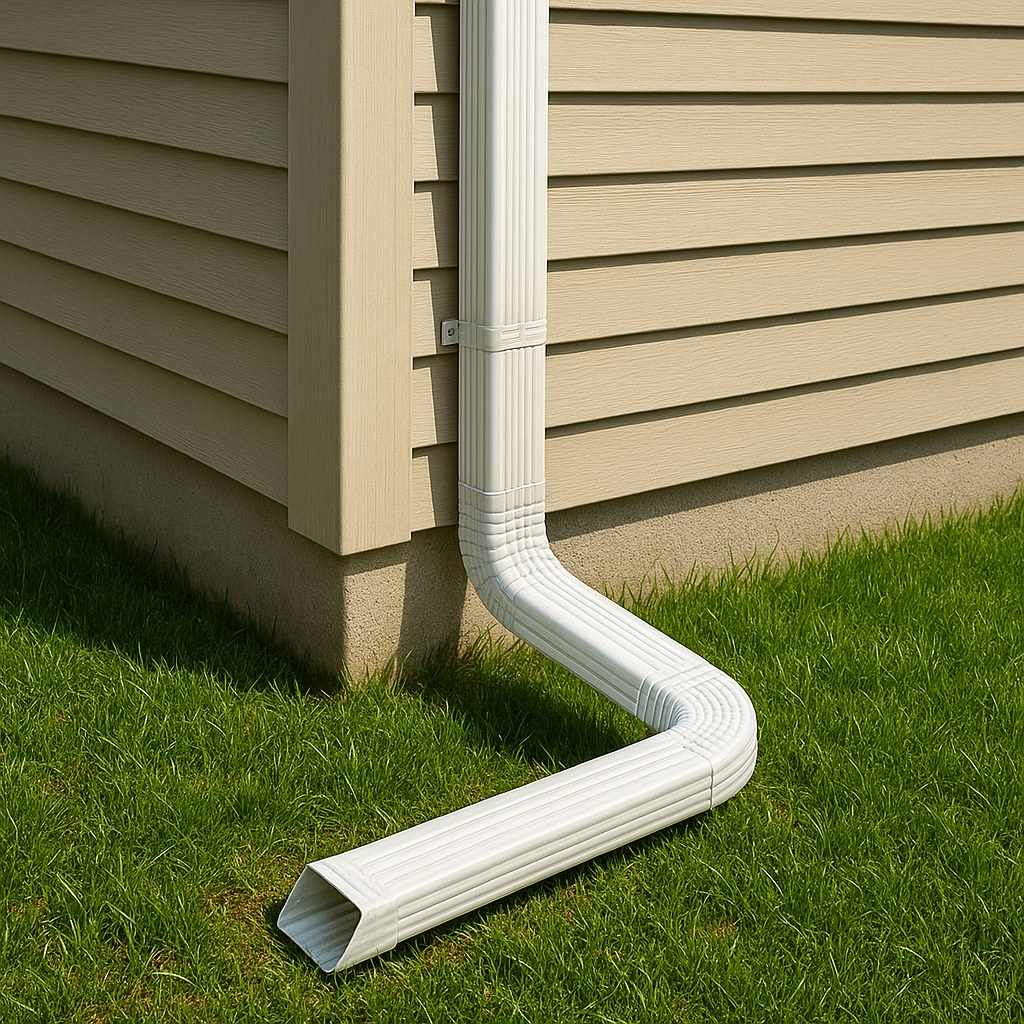
If the Pipe Is Loose Higher Up
You can tighten a strap you reach while standing on the ground. For anything higher, or for a connector at the gutter, call a gutter company. Holding a long pipe while drilling overhead is an easy way to fall.
Here is what they do. With a flexible connector, a ribbed tube at the top, they loosen the clamp, line the pipe up, and tighten it again. With a rigid elbow, they remove the upper strap, center the elbow under the outlet, refasten it in solid backing, and work down so the pipe hangs straight.
Step 3: Relocating a Downspout Entirely
Move it when the outlet is at the high end of the gutter, the only place to drain is a patio, or a new addition or walkway is in the way. The job depends on the gutter.
- Sectional vinyl gutters come apart at the joints. The installer swaps the old outlet piece for a plain section and snaps a new drop outlet in at the new spot.
- Seamless metal gutters are one long piece. The installer cuts a new outlet with a special tool and patches and seals the old hole.
Either way, the gutter has to slope toward the new outlet, so the run may need to be rehung. Often it is simpler to leave the old downspout and add a second one. Building America suggests at least one for every 50 feet of gutter.
Burying the Pipe
A buried line hides the extension, but it can clog where you cannot see it, and digging can hit utilities. Contact 811 a few business days before you dig. The service is free. Check local rules on where the pipe may empty. Never connect roof water to the sanitary sewer.
What Does Downspout Work Cost?
HomeGuide puts replacing or adding one downspout at $30 to $75, with new runs at $2 to $4 per linear foot installed. Replacing all four or five downspouts runs $220 to $625. Thumbtack's gutter repair average is $215 to $685 if the gutter itself needs work too.
When to Call Someone
- Water still reaches the basement or crawl space after you extend the downspout.
- Cracks in the foundation are widening, or a wall is bowing.
- The gutter sags, pulls away, or holds water.
- You need a new outlet cut into a seamless gutter.
Ask the gutter company where the new downspout will go, where the water will end up, how the old outlet will be sealed, and whether the gutter slope must change.
In a rental or condo, get permission before you fasten anything. A clip-on extension and a splash block need no drilling.