Feb 28, 2026
How to Fix Low Flow and Clean Your Pool Filter
If your pool pressure is high and water flow is low, your filter likely needs cleaning. This guide walks you through cleaning sand, cartridge, and DE filters yourself.
Owning a pool often feels like a balancing act between enjoyment and maintenance. One day the water is sparkling, and the next, the jets feel weak and the water looks a little hazy.
Looking for more guidance? Take a look at our Repairs overview.
If you’ve noticed your pool pump straining or the water flow slowing down, don’t panic. This is rarely a sign of broken machinery. almost always, it just means your filter is doing its job a little too well—it has caught so much debris that water can no longer pass through easily.
Cleaning a pool filter is a standard part of ownership. It’s a routine chore, not a disaster. Whether you have a sand, cartridge, or Diatomaceous Earth (DE) filter, the process is straightforward. This guide will help you identify your filter type and get your water flowing freely again.
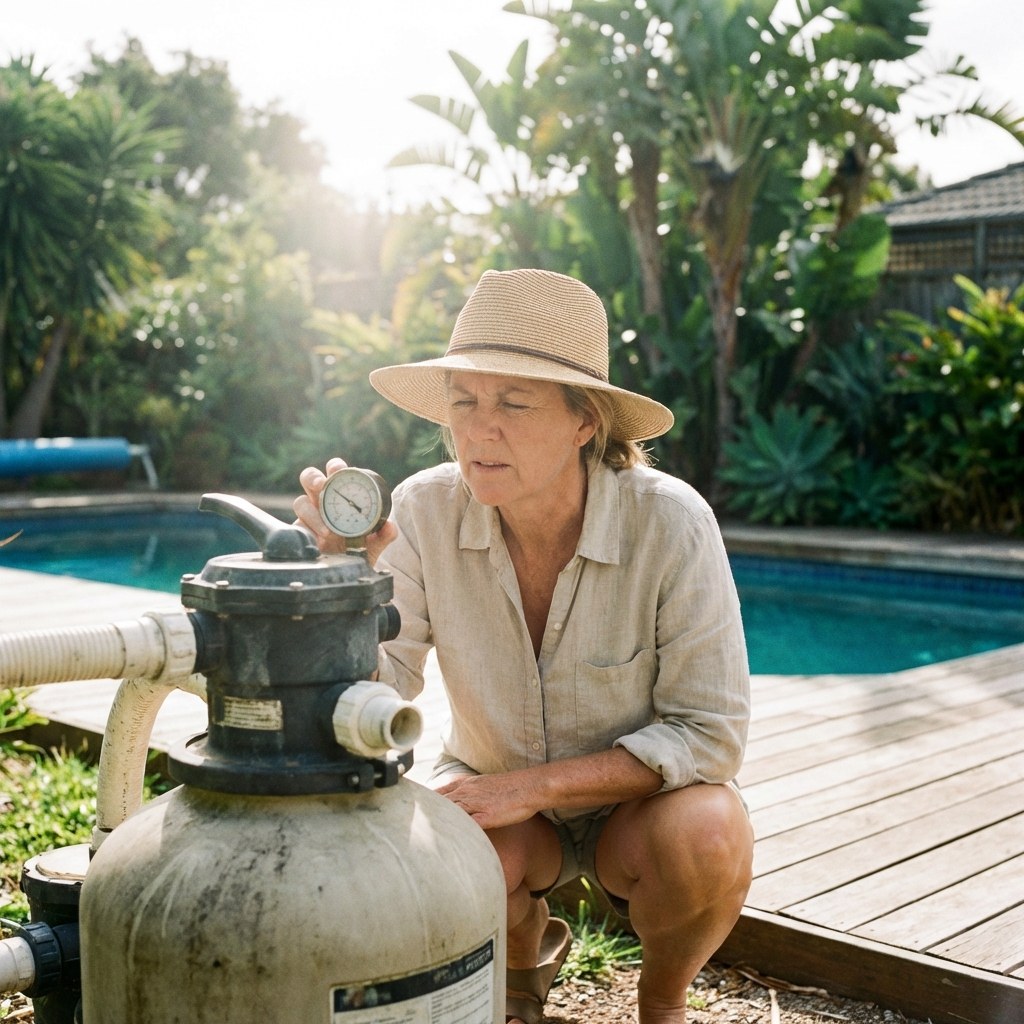
Signs Your Filter Is Clogged
Before you start taking things apart, let’s confirm the filter is actually the culprit. Here are the classic symptoms of a clogged filter:
- High Pressure Readings: The pressure gauge on your filter tank reads 8–10 psi higher than its "clean" starting pressure.
- Low Flow: The return jets (where water enters the pool) feel weak or barely bubble.
- Cloudy Water: The water isn't turning over fast enough to stay clear.
- Ineffective Skimmers: Debris floats on the surface because the suction isn't strong enough to pull it in.
Is This Safe to DIY?
Yes, usually. Cleaning a filter is a standard homeowner task. However, you are working with pressurized systems.
- Stop and call a pro if: You see cracks in the filter tank, the clamp band looks corroded or damaged, or if you are unsure how to release pressure safely.
- Safety First: Always turn off the pump and release air pressure via the relief valve before opening any filter tank.
Step 1: Identify Your Filter Type
You can’t clean the filter until you know what kind you have. Go to your pool equipment pad and look at the large tank.
- Sand Filter: Usually a large, round tank with a "multiport valve" (a handle you can push down and turn) on the top or side. It uses special sand to trap dirt.
- Cartridge Filter: A tank that usually has a removable lid secured by a clamp band. It contains pleated fabric cylinders (cartridges) inside. There is no multiport valve.
- DE (Diatomaceous Earth) Filter: Looks similar to a sand filter and has a multiport valve or a push-pull piston valve. It uses a fine white powder to coat internal grids.
Once you know your type, scroll to the matching section below.
Step 2: Cleaning Your Specific Filter
Option A: How to Clean a Sand Filter
Time required: ~15 minutes
Sand filters are the easiest to maintain because you don't need to open the tank. You clean them by reversing the water flow, a process called "backwashing."
- Turn off the pump. Never move the valve handle while the pump is running.
- Set to Backwash. Push the handle down and rotate it to the "Backwash" setting.
- Run the pump. Turn the pump on. Watch the sight glass (a small clear vial on the valve). The water inside will look dirty. Run it for about 2 minutes or until the water in the glass runs clear.
- Rinse. Turn off the pump. Switch the handle to "Rinse." Turn the pump back on for 30 seconds to settle the sand.
- Reset. Turn off the pump. Switch the handle back to "Filter." Turn the pump on.
- Check Pressure. The gauge should now read significantly lower, likely back to your baseline (usually 10–15 psi).
Option B: How to Clean a Cartridge Filter
Time required: ~35 minutes
Cartridge filters require a bit more manual labor but offer excellent filtration.
- Depressurize. Turn off the pump. Open the air-relief valve on top of the tank to release pressure (you'll hear a hiss).
- Open the tank. Remove the clamp holding the lid on using a ratchet wrench. Lift off the lid.
- Remove cartridges. Lift the pleated elements straight up and out.
- Spray them down. Using a garden hose with a spray nozzle, spray each pleat from top to bottom. Don't use a pressure washer, as it can tear the fabric.
- Inspect. Look for tears or cracked plastic end caps. If they are damaged, you must replace the cartridge.
- Reassemble. Put the clean cartridges back in. Secure the lid and clamp tightly.
- Restart. Turn the pump on. Keep the air-relief valve open until water sprays out, then close it.
Option C: How to Clean a DE Filter
Time required: ~30 minutes
DE filters are a hybrid: you backwash them like a sand filter, but you must add fresh DE powder afterward.
- Backwash. Turn off the pump, set the valve to "Backwash," and run until the sight glass is clear (about 2 minutes).
- Reset. Turn off the pump, return the valve to "Filter," and open the air-relief valve on the tank.
- Add DE Powder. Turn the pump on. Once water spurts out the air relief valve, close it.
- Recharge. Slowly pour the required amount of DE powder (check your manual, usually 1 lb per 10 sq. ft. of filter area) into the pool skimmer while the pump is running. The suction will pull the powder into the filter to coat the grids.
Time and Cost Expectations
Maintaining your filter is one of the lowest-cost repairs you can do, provided nothing is broken.
- DIY Cost: $0–$20. (Cost of water for backwashing or a bag of DE powder).
- Professional Service Call: $100–$200.
- Replacement Parts (if needed):
- New Cartridge: $40–$100.
- New Sand (every 5-7 years): $100–$200 (heavy labor).
- New DE Grids: $150–$300.
Pro Tip: If you clean your filter and the pressure returns to a high level within just a few days, your filter media (the sand, cartridge, or DE grids) may be fouled with oil or worn out. At that point, cleaning won't help, and replacement is necessary. Casa is a great tool for tracking when you last replaced your filter media so you aren't guessing if it's "too old."
When to Call a Professional
While cleaning is simple, sometimes the issue is deeper. Call a pool technician if:
- The pressure gauge never drops, even after cleaning.
- Sand or DE powder is blowing back into the pool through the jets.
- The filter tank is leaking water.
Keep Your Pool Running Smoothly
A clean filter is the heart of a healthy pool. By keeping an eye on your pressure gauge and performing this routine maintenance, you protect your expensive pool pump from burning out and ensure your water stays inviting.
If keeping track of filter schedules, chemical balances, and equipment maintenance feels overwhelming, download the Casa app. Casa helps you organize your home’s maintenance history and prepares you to handle routine care with confidence.