

Jan 22, 2026
What to Do When Your Garbage Disposal Wont Stop Running
A garbage disposal that won't turn off is a stressful and potentially unsafe situation. Learn how to safely cut the power and diagnose common causes.
Hearing your garbage disposal run continuously, even after you’ve flipped the switch, can be unsettling. It’s a noisy problem that feels urgent, and for good reason. A motor that won’t shut off is not just a nuisance; it’s a potential hazard.
Looking for more guidance? Take a look at our Repairs overview.
The good news is that this is a known issue with a logical set of causes, most often related to a faulty switch or a jam. The most important first step isn’t to figure out why it’s running, but to safely turn it off.
This guide will walk you through how to safely cut power to your disposal and then investigate the most common reasons it might be stuck in the "on" position.

Why Your Garbage Disposal Might Be Stuck On
When a garbage disposal won't shut off, it’s usually due to one of a few common issues:
- A Stuck Wall Switch: The physical switch on your wall or countertop can fail internally, essentially getting stuck in the "on" position even if the toggle feels normal.
- A Jammed Impeller: Debris lodged in the disposal's grinding components (called impellers) can sometimes cause the internal switch to malfunction.
- Faulty Internal Components: The disposal unit itself can fail, leading to the motor running continuously.
- Automatic Activation Issues: Some advanced models have sensors or automatic features that can malfunction.
No matter the cause, the first response is always the same: cut the power at the source.
Step 1: Immediately Cut Power to the Garbage Disposal
Your top priority is to stop the unit from running. Do not put your hands or any objects into the sink drain while the disposal is making noise.
There are two ways to cut power. Try them in this order:
-
Unplug the Unit: Look under your sink. Most garbage disposals are plugged into a standard electrical outlet. If you can safely reach it, unplug the power cord. The disposal should stop immediately. If it does not have a plug, it is "hardwired," and you must move to the next step.
-
Turn Off the Circuit Breaker: Find your home’s main electrical panel (often in a basement, garage, or utility closet). The breakers should be labeled. Look for the one dedicated to the "Kitchen," "Disposal," or "Sink." Flip that breaker firmly to the OFF position. This will cut all power to the circuit, and the disposal will stop running.
If the disposal continues to run after you’ve flipped the breaker you believe controls it, you may have a more serious electrical issue. Stop immediately and call a qualified electrician.
Step 2: Investigate the Wall Switch
With the power safely off at the breaker, you can now investigate the cause. A faulty wall switch is the most common reason a disposal gets stuck on.
What to do:
- Leave the circuit breaker OFF.
- Go to the wall switch that operates the disposal. Flip it on and off a few times. Does it feel sticky, loose, or different than usual?
- If the switch feels faulty or you want to be thorough, you can check for loose wiring. Use a screwdriver to remove the switch’s faceplate.
- Safety Check: Even with the breaker off, it's wise to confirm there is no power. Use a non-contact voltage tester inside the switch box. The tester should not light up or make a sound.
- If the wires connected to the switch screws appear loose, gently tighten them with your screwdriver.
- Reattach the switch cover plate.
After checking the switch, you can proceed to the next step before turning the power back on.
Step 3: Check for an Internal Jam
Sometimes, an object stuck inside the disposal can interfere with its internal mechanisms, causing it to run continuously. Clearing this jam may resolve the issue.
Always ensure the power is off at the circuit breaker before performing this step.
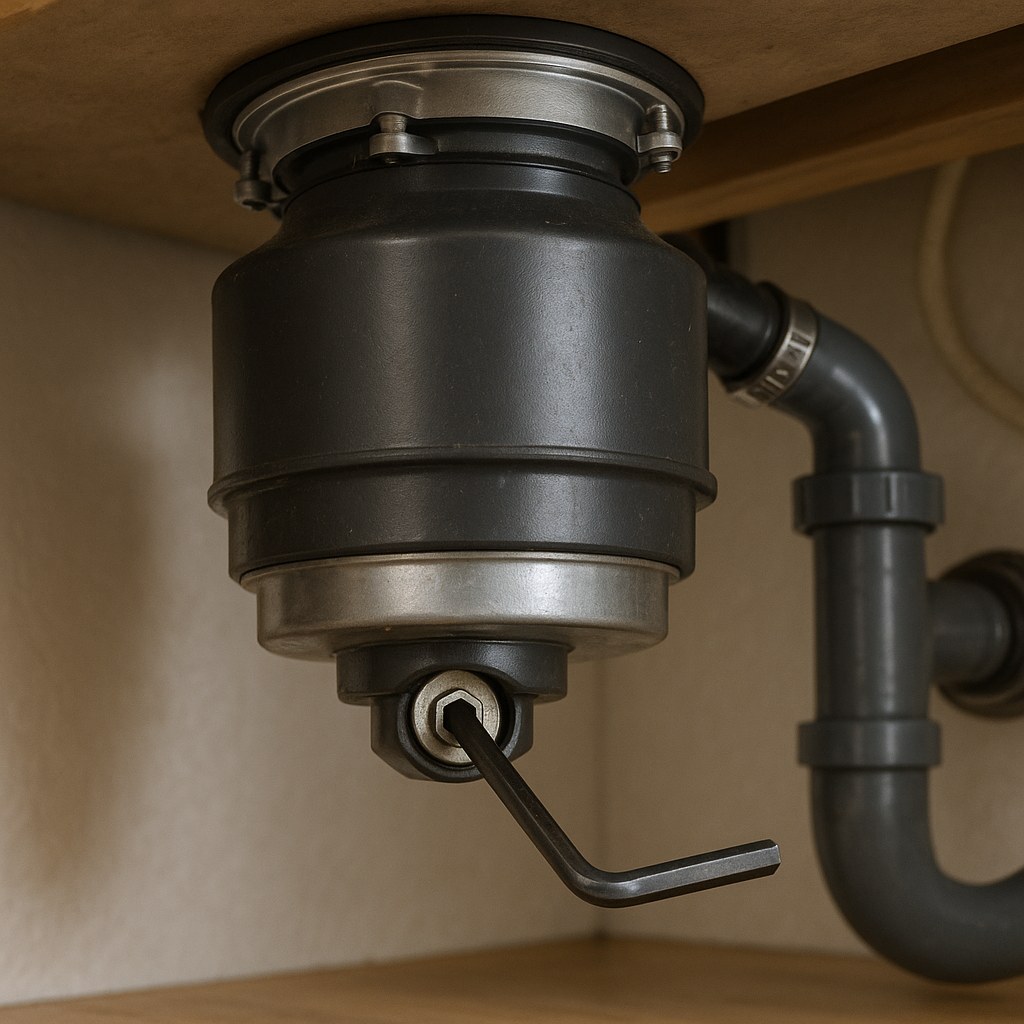
- Find the small hexagonal opening on the very bottom of the disposal unit. Your disposal likely came with a small, S-shaped hex key (sometimes called a jam-buster wrench) for this purpose. If you can't find it, a standard 1/4-inch hex key will work.
- Insert the key into the socket and turn it back and forth. You should feel the internal impellers moving freely. This action will dislodge most common jams.
- Once the impellers move freely, shine a flashlight down the sink drain. Use tongs or pliers—never your fingers—to remove any visible debris you may have dislodged.
Step 4: Reset the Unit and Test
Now that you’ve checked the switch and cleared any potential jams, it’s time to see if the problem is solved.
- Locate the small red or black reset button, usually on the bottom of the disposal unit.
- Press the button firmly until it clicks and stays in. If it was tripped, this will reset the unit's internal motor protection.
- Make sure the wall switch for the disposal is in the OFF position.
- Go back to your electrical panel and flip the breaker back to the ON position.
- Return to the sink and listen. The disposal should be silent.
- Try turning the disposal on and off with the wall switch.
If it now operates normally, you've likely fixed the problem. If the disposal starts running immediately after you restore power (even with the switch off), the switch itself has likely failed and needs to be replaced.
When to Call a Professional
It's important to know when to stop and call for help.
-
Call an Electrician if:
- You are not comfortable opening the wall switch to check the wiring.
- The disposal continues running even after you flip the circuit breaker.
- You've determined the wall switch is faulty and you don't want to replace it yourself.
-
Call a Plumber if:
- You have followed all the steps above, and the disposal still runs continuously once power is restored.
- You suspect the disposal unit itself is broken internally. A plumber can safely replace the entire unit.
Typical Time and Cost
- DIY Troubleshooting: 15-30 minutes. The only cost may be for a new switch ($10-$20) if you choose to replace it yourself.
- Professional Service Call: Hiring an electrician or a plumber typically costs between $100 and $300 for the initial visit and diagnosis. If the entire garbage disposal unit needs to be replaced, you can expect to pay for the new unit plus an hour or two of labor.
Your Home, Under Control
A runaway garbage disposal can be a startling experience, but by following a safe and logical process, you can quickly regain control. Always prioritize safety by cutting the power before you do anything else. From there, a few simple checks are often all it takes to identify the problem.
Managing your home’s systems, like knowing which breaker goes to which appliance, is a key part of feeling prepared. The Casa app can help you keep track of these details, so you have the information you need right when you need it.
For more straightforward guidance on maintaining your home, download the Casa app. We're here to help you handle any issue with calm confidence.