

Updated Nov 23, 2026
Why Your Oven Door Won't Close and How to Fix It
Find out what is holding an oven door open, which gaps are normal, what to clean and tighten, and why you should not force or bake with a bad door.
Start with the simple things. Pull out the racks, look for foil, a pan edge, or burned crumbs on the frame, and wipe the bottom lip once it is cool. If the door still stays open, look at the hinge and the seal. A gap along the bottom edge is often normal. Do not force the door, and do not bake with it propped open.
Looking for more guidance? Take a look at our Repairs overview.
If the door hangs crooked, feels loose, or drops, stop using the oven until the hinge is repaired.
| What you see | Likely cause | Do this |
|---|---|---|
| Won't close the last inch | Rack, foil, or food | Clear it, wipe the frame |
| Bounces back | Seal out of its channel, or grease | Reseat, clean the frame |
| Crooked, or hangs low | Loose or bent hinge | Stop, technician |
| Stays open on its own | Weak or broken hinge spring | Stop, technician |
| Gap only at the bottom | Often normal | See below |
| Won't open | Locked after self-clean | Let it cool, then check |
| Heat leaks at a side or top | Worn seal or hinge | Seal, then hinge |
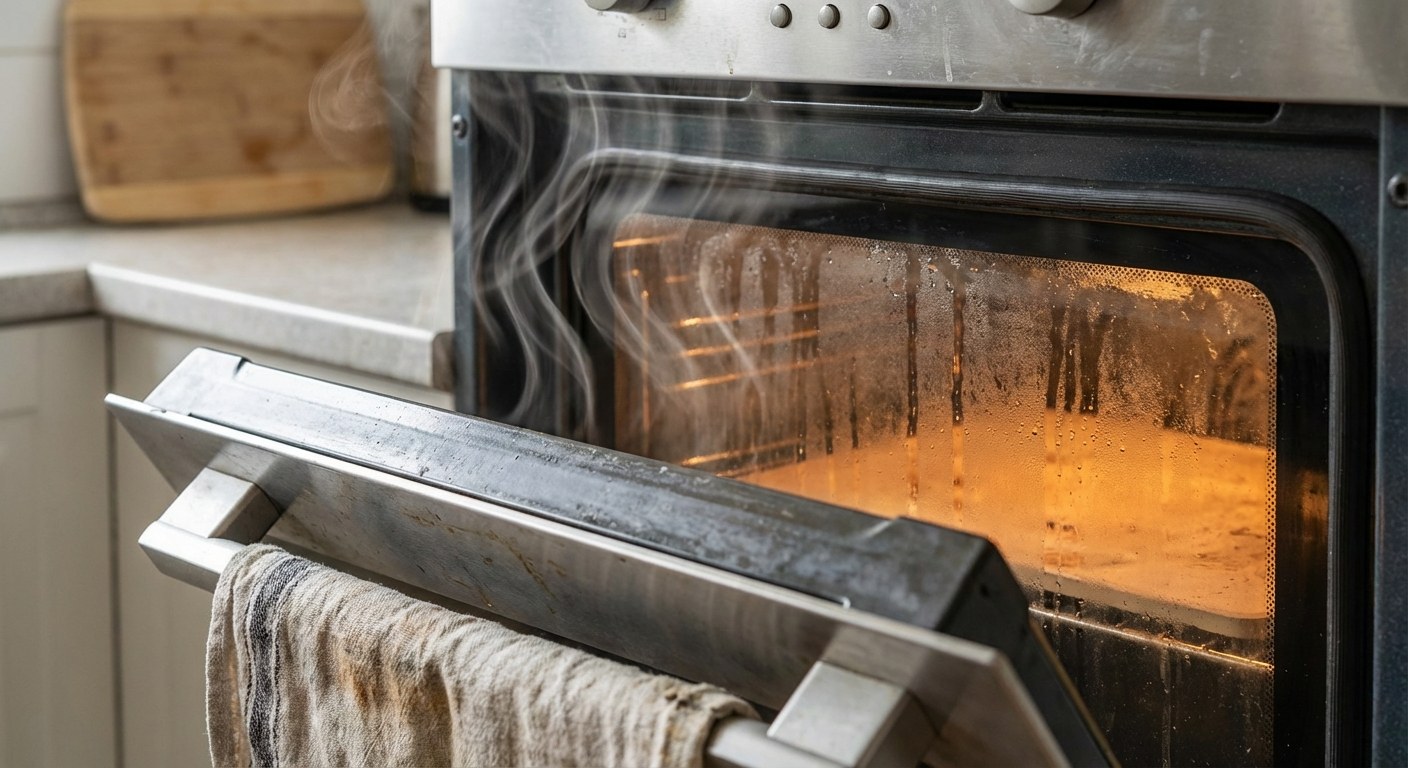
Which Gaps Are Normal?
GE says it is normal to have an open gap at the bottom of an oven door, because it lets air in to replace what goes out the vent. A light check is helpful at the sides and top, but light along the bottom is not proof of a leak.
Check It Safely
- Turn the oven off and let it cool completely. Do this in daylight.
- Take out the racks, the broiler pan, and any foil.
- Open the door slowly and look at the hinge on each side. Does it look straight? Do not put your fingers near the gap.
- Look around the seal and the frame for crumbs, melted plastic, or a hinge screw on the floor.
- Close the door gently. Where does it stop?
Clean the Door and Frame
- Wipe the frame, the edge of the door, and the bottom lip with warm water and dish soap.
- Use a soft brush and a wooden skewer for baked-on grease. Do not use a scraper on glass or enamel.
- Dry it fully.
- Do not spray anything on the seal, and do not use oven cleaner near it.
Do not scrub the seal. GE says most woven fiberglass gaskets do not require cleaning and can be damaged if cleaned. Some older ovens use a silicone gasket that can be washed. Check your manual.
Reseat a Loose Seal
- With the oven cool, look for a section that has come out of its clip or channel.
- Press it back gently with your fingers. Do not pull or glue it.
- If it is torn, flat, or missing, order the part by model number, or have it fitted.
- A woven seal should not be reused if it is frayed.
Hinges
Oven hinges hold a heavy spring. Do not take the door off or move the hinge lever unless your manual shows how and you have help. If a screw is loose on the outside face of the door, you can snug it, but a hinge that is loose in the frame, bent, or sprung needs a technician.
If the Door Is Locked
After a self-clean cycle the latch may hold until the oven is cool. Wait an hour or more. Check that the oven is not in a lock mode. If it is still locked when cool, follow your manual. Do not pry.
When to Call a Technician
- The door drops, hangs crooked, or will not stay up.
- A hinge is bent, or a spring is loose.
- The seal is torn, or the door glass moves.
- The oven will not heat, or heats only with the door open.
- You smell gas, or the door is off.
Ask for the price with the hinge or seal included, and compare it with a replacement. Do not bake with the door tied or held shut. A door that does not seal wastes heat, and can overheat nearby parts and cabinets. Thumbtack puts the national average for oven repair at $136 to $346. HomeGuide lists an oven door at $175 to $700 and a door gasket at $100 to $200.