

Jun 16, 2026
Maintaining Faucet Aerators and Showerheads
Learn how to easily remove mineral buildup from your faucets and showerheads to restore water pressure and protect the lifespan of your plumbing fixtures.
If you notice water spraying sideways from your bathroom sink or a sudden drop in pressure from your showerhead, it is easy to assume you have a significant plumbing problem. Fortunately, the culprit is usually much simpler: mineral buildup.
Looking for more guidance? Take a look at our Maintenance overview.
Tap water contains dissolved minerals, primarily calcium and magnesium. Over time, these minerals are left behind as water evaporates, leaving a crusty white or green residue on your plumbing fixtures. While clearing this buildup might seem like a standard cleaning chore, it is actually a vital preventive maintenance task. Taking a few minutes to descale your fixtures prevents permanent damage and keeps your plumbing running smoothly.
What Happens If You Ignore It
When mineral scale is allowed to accumulate, it progressively blocks the flow of water. In the short term, this is simply annoying. In the long term, restricted water flow causes back pressure inside the fixture itself.
Faucets and showerheads are designed for water to pass through them freely. When the exit path is blocked, the trapped water searches for the path of least resistance. This pressure can force water into the internal cartridges or seals of the faucet, causing leaks at the handles or around the base of the fixture. Furthermore, heavy mineral buildup can effectively glue the components together. If left too long, the removable parts of your faucet can become completely fused, making future repairs impossible without replacing the entire unit.
What This Task Protects
- System Lifespan: Keeping water flowing freely prevents undue stress on the internal rubber gaskets and plastic valves inside your fixtures, helping them last years longer.
- Efficiency: A partially blocked showerhead provides poor water pressure, often leading you to take longer showers just to rinse off. Restoring the flow helps you use water more efficiently.
- Fixture Finish: Hard water stains left on the outside of fixtures can eventually etch into the metal finish, causing permanent discoloration or pitting.
Step-by-Step Checklist for Descaling Fixtures
The target of this maintenance is the aerator. The aerator is the small, round cap screwed into the tip of your faucet where the water comes out. Inside, it holds a tiny mesh screen that mixes air into the water stream to reduce splashing.
Here is a simple process to clear mineral buildup from aerators and showerheads using basic household items.
What you need:
- Standard white vinegar
- A small plastic sandwich bag
- A rubber band
- An old toothbrush
- Slip-joint pliers
- A thick rag or small towel
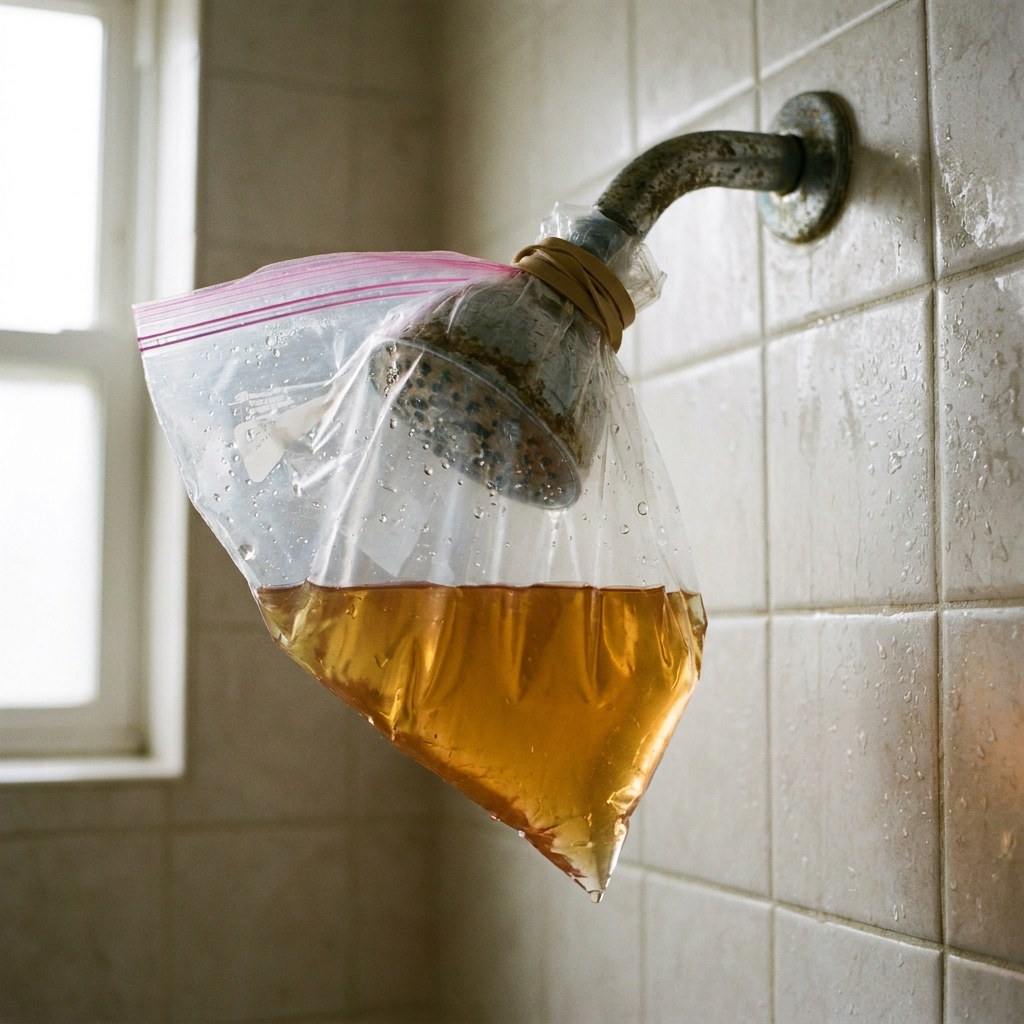
The Bag Method (For showerheads and stuck aerators)
- Fill a small plastic bag halfway with standard white vinegar.
- Submerge the showerhead or the tip of the faucet directly into the vinegar.
- Secure the bag tightly to the neck of the fixture using a rubber band.
- Leave it to soak for roughly two to four hours. The mild acid in the vinegar will safely dissolve the mineral scale.
- Remove the bag and run the water on hot for a minute to flush out the loosened debris.
The Removal Method (For a deeper clean)
- Wrap a thick rag around the aerator at the tip of your faucet to protect the metal finish.
- Gently grip the rag-covered aerator with your pliers and turn counterclockwise to unscrew it.
- Once removed, take note of how the internal parts (the screen, the flow restrictor, and the rubber washer) fit together so you can reassemble them correctly.
- Drop the parts into a small bowl of white vinegar to soak for an hour.
- Use an old toothbrush to scrub away any remaining debris from the mesh screen.
- Rinse the parts, reassemble them, and screw the aerator back onto the faucet by hand until it is snug. Turn on the water to ensure there are no leaks around the threads.
How Often This Should Be Done
For most homes, checking and cleaning your aerators and showerheads every six months is sufficient. If your home has highly mineralized "hard" water and you do not have a whole-home water softening system, you may need to perform this task every three to four months.
Signs You Have Waited Too Long
Your fixtures will usually tell you when they need attention. Look out for:
- Water spraying in multiple, uneven directions.
- A noticeable drop in water pressure isolated to one specific sink or shower.
- Visible crusty white, gray, or pale green buildup around the water spouts.
- An aerator that refuses to unscrew, even with the gentle use of pliers.
The Cost of Maintenance vs. Neglect
The cost of this preventive task is exceptionally low. A bottle of white vinegar costs roughly three to five dollars, and the process takes only a few minutes of active effort.
In contrast, neglecting the buildup can lead to replacing the fixture entirely. A new mid-range bathroom faucet or showerhead typically ranges from $75 to $200. If the restricted flow causes an internal leak that damages the vanity cabinet below the sink, or if you need to hire a professional plumber to install the new fixture, those costs can easily exceed $300.
Safety Boundaries
While this is a highly approachable task, it helps to know your limits so you do not accidentally damage your plumbing.
Safe to try yourself: Soaking fixtures in vinegar, gently unscrewing aerators, and scrubbing screens are all perfectly safe tasks for any homeowner.
Worth waiting or monitoring: If you notice a very slight reduction in water flow, you can monitor it until your next scheduled maintenance day. It does not require an immediate drop-everything response.
Time to stop and call a professional: If your faucet leaks from the handles or the base when the water is turned on, the internal seals may have already failed, and the cartridge likely needs replacing. Additionally, if an aerator is completely stuck, do not force it. Applying too much twisting pressure with a wrench can warp the metal or snap the faucet neck entirely. If it will not budge after a long vinegar soak, it is best to consult a plumber.
How to Build This Into Your Home Maintenance Schedule
Preventive tasks are easy to forget until a problem becomes obvious. The best approach is to tie this chore to a recurring event, such as the start of spring and the start of autumn. While you are soaking your showerheads, you can use the downtime to check underneath your sinks for slow drips or test the batteries in your smoke detectors.
Casa is designed to help you manage exactly this kind of routine. By setting up a seasonal checklist in your Casa profile, you can keep track of these infrequent tasks without needing to hold them in your memory.
Recap
Cleaning your faucet aerators and showerheads is a simple, low-cost way to maintain your home's plumbing. By soaking away mineral buildup every six months, you restore your water pressure, prevent internal leaks, and extend the life of your fixtures. It requires little more than white vinegar and a few minutes of your time, making it one of the most rewarding maintenance tasks a homeowner can perform.
Ready to make home maintenance manageable? Download the Casa app today to organize your seasonal checklists, track your repairs, and keep your home running smoothly.