

Updated Nov 23, 2026
How to Fix a Wobbly Ceiling or Portable Fan
Stop a ceiling fan wobble by cleaning, tightening, and balancing the blades, and spot the mount problems that mean you should leave it off and call.
A fan that shakes or wobbles is often unbalanced. Most ceiling fan wobbles come from dust, loose blade screws, or blades that are out of balance, and you can fix those with the fan off at the breaker. If the fan moves where it meets the ceiling, stop. That is a mounting problem, and a falling fan can injure someone.
Looking for more guidance? Take a look at our Repairs overview.
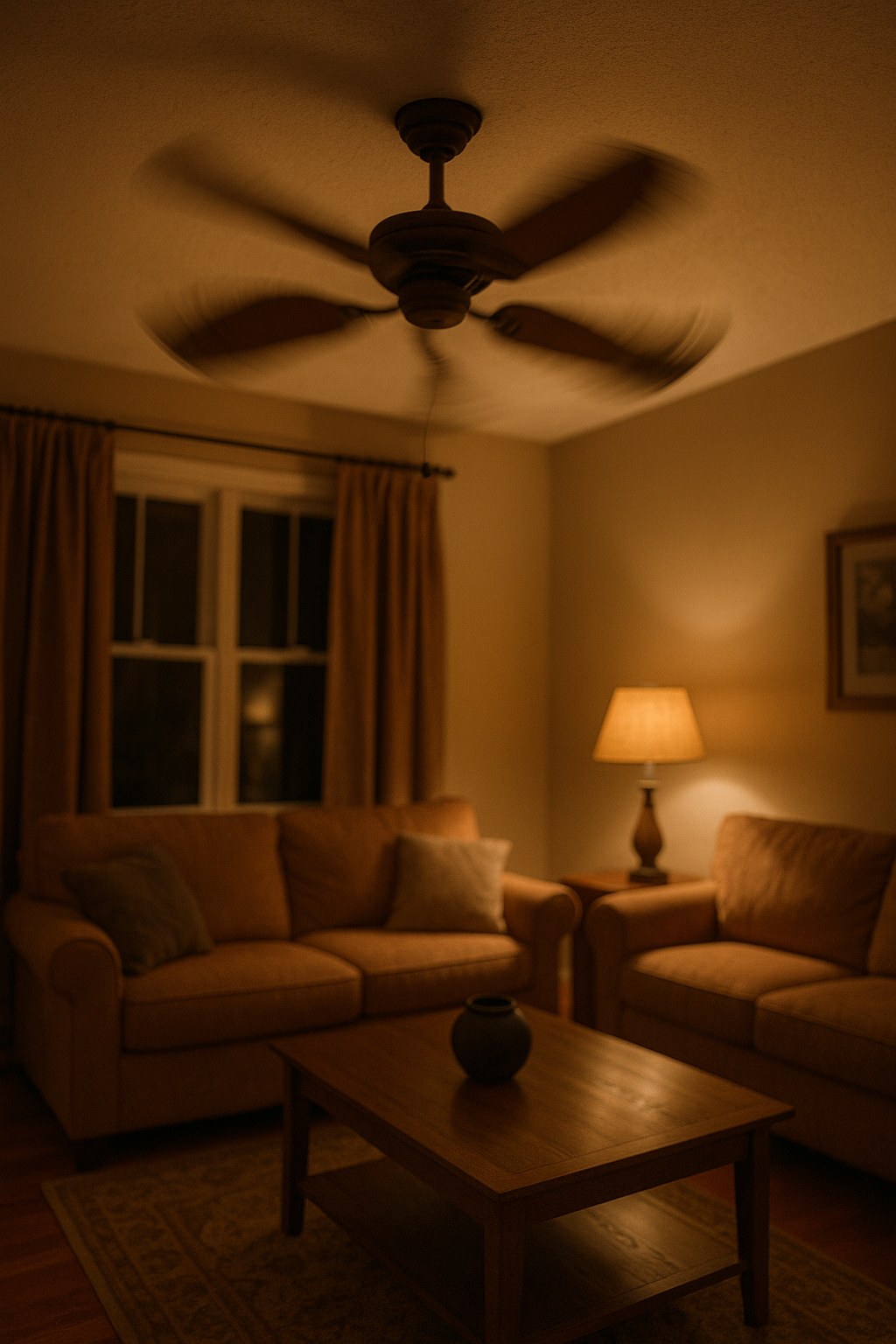
Why Is My Fan Wobbling? The Most Common Culprits
- Dust. It settles unevenly, and a little weight at the tip of a long blade makes a big difference. Suspect it first when the wobble came on slowly.
- Loose blade screws. Vibration works them out over time, and one drooping blade throws off the rest.
- A bent or warped blade or arm. Often from a bump, a hanging wreath, or humidity on a fan that isn't rated for a porch or bathroom.
- Blades that don't match in weight. Common after one blade was replaced.
- A loose mount. Screws at the bracket, the rod, or the ceiling box. This is the one you don't fix yourself.
- Poor installation. If it has wobbled since the day it went up, suspect the mount or a mixed-up blade set.
First, See Where It Moves
Run the fan on low and look from across the room.
| What moves | Likely cause | What to do |
|---|---|---|
| Blades dip unevenly, ceiling mount still | Dust, loose screws, or balance | Follow the steps below |
| One blade looks lower | Bent arm or loose screw | Tighten, then replace the arm if it is still off |
| Rod swings a little at high speed | Often normal | Check screws and balance |
| Canopy or ceiling plate moves | Loose bracket or box | Turn it off and call an electrician |
| Grinding, humming, or a hot smell | Motor, wiring, or control | Turn it off and call |
Most fans wobble a little at top speed. A wobble that is growing, or that shakes the canopy, is different.
Is It on the Right Box?
A fan needs more support than a light. Hunter tells installers to mount to building structure or a box marked acceptable for fan support. If the fan replaced a light fixture and nobody knows what box is up there, leave it off until an electrician looks.
How to Fix a Wobbly Ceiling Fan
Allow under an hour. You need a stable stepladder, a Phillips screwdriver, a cloth, a yardstick, and a balancing kit if cleaning and tightening aren't enough. Hunter also suggests checking that the blade tips are at least 30 inches from the nearest object.
- Turn the fan off, turn off its breaker, and wait for the blades to stop. Try the switch and chain to make sure it is dead.
- Set a stable stepladder to one side so you never reach across a blade. Have someone nearby.
- Wipe both sides of every blade. Support the blade with your other hand so you don't bend the arm.
- Wiggle each blade gently near its arm. Any play means a loose screw. Tighten the screws that hold each blade to its arm, and each arm to the motor. Snug is enough.
- Look for cracks, bends, or a blade from a different set. Do not mix blades between fans. Sight down the edge of each blade toward the motor. Hunter says any curve means it is warped, and warped blades cannot be balanced.
- With a yardstick against the ceiling, turn the blades by hand past the same point. Each tip should pass at the same height.
- Come down, turn the breaker on, and run it on low, then medium. Stand clear.
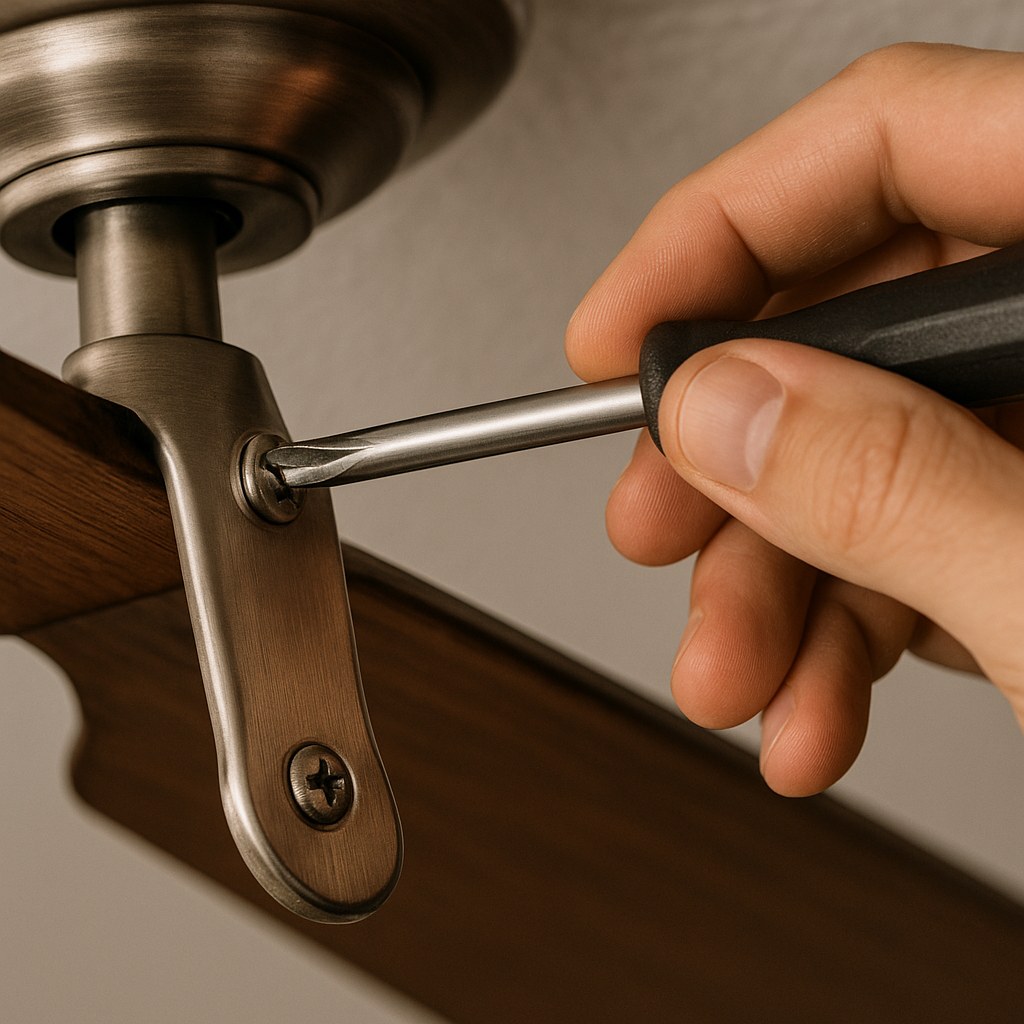
If a tip sits higher or lower after tightening, order a new arm for your model. Forcing a bent arm can crack it. If a screw won't tighten because its hole is stripped, the arm or blade needs replacing. Order blades as a matched set by model number.
How to Balance a Ceiling Fan
Use the balancing kit that came with the fan, one sold by the maker, or a kit from a home improvement store. It holds a plastic clip and a few stick-on weights.
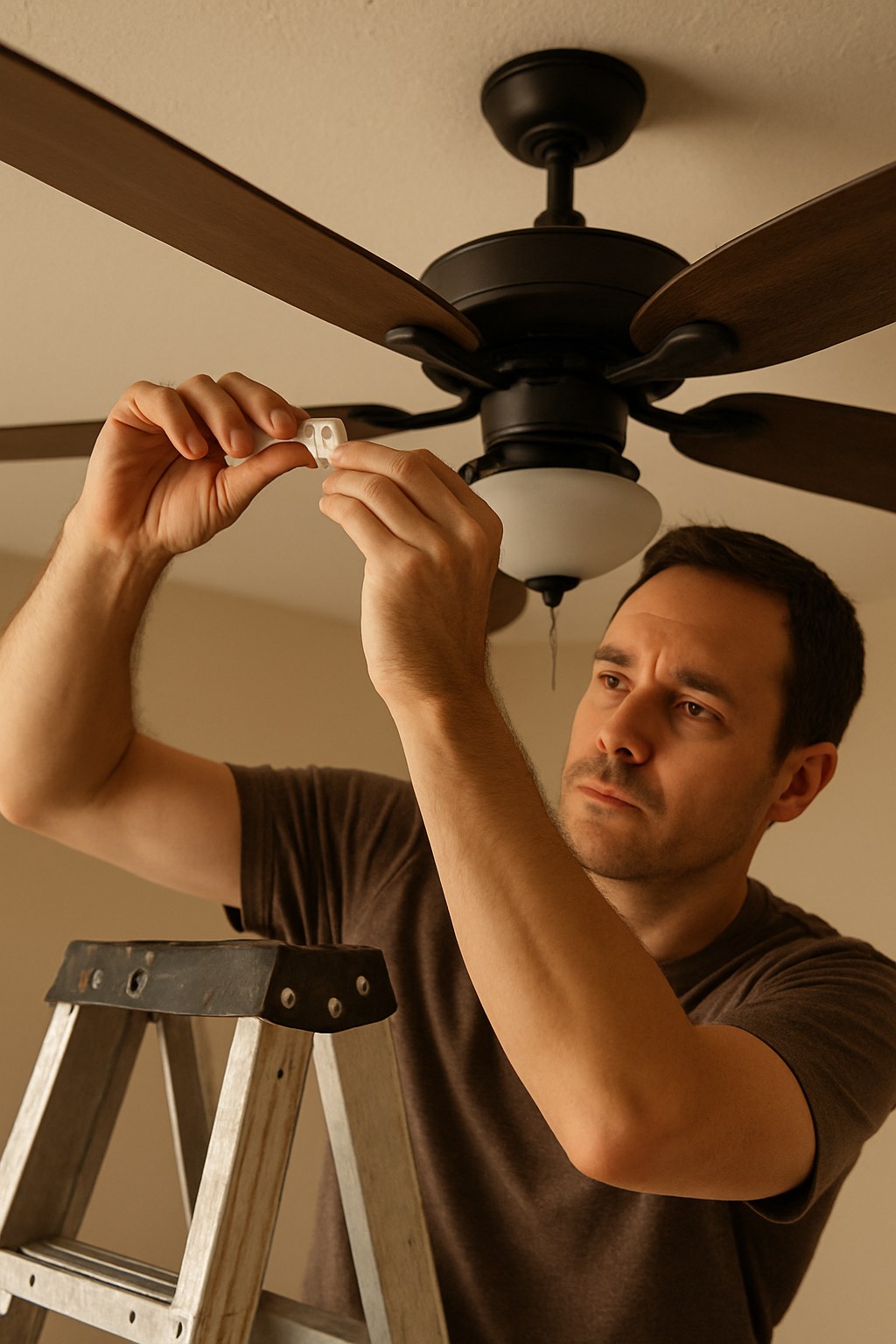
- Run the fan at the speed where the wobble is worst, then turn it off and let the blades stop.
- Turn off the breaker. Put the clip on the middle of one blade's back edge.
- Come down, restore power, and run the fan. Note whether it is better or worse.
- Repeat for each blade, turning the breaker off every time you climb.
- On the blade that improved most, move the clip toward the tip and then the motor until the wobble is smallest.
- Stick the weight on top of that blade, in line with the clip. Remove the clip and test.
A clip left on at high speed can fly off. Use low or medium while testing. If no blade gets better with the clip, try two blades side by side, or go back and recheck the screws and tip heights. Balancing can't make up for a bent arm or a loose mount.
Can a Wobbly Ceiling Fan Fall?
A fan properly mounted on a fan-rated box is very unlikely to fall because of a slight wobble. A fan on a box meant for a light, or with loose mounting screws, can work itself free over time. Treat these as a reason to turn it off today: a canopy that rocks, new cracks or dust on the ceiling around it, a rod that clunks, or a wobble that is worse each week.
When to Call
Call an electrician if the canopy, bracket, rod pin, or box is loose, if the fan-support rating is unknown, or if tightening would mean lowering the canopy. A handyman can balance blades, but wiring and the ceiling box are an electrician's work.
The electrician shuts off the power, lowers the canopy, checks the bracket, the rod pin, and the set screw, and confirms that the box is fan-rated and fixed to framing. If it isn't, they can usually fit a brace and box made for fans through the same hole. Tell them the fan's model, how long it has wobbled, whether it replaced a light, and how high the ceiling is. If you rent, ask the owner to arrange it.
Thumbtack data puts the national average for ceiling fan repair at $141 to $391. If an electrician has to reset or replace the fan, installation runs $146 to $351 for the work alone.
How to Fix a Wobbly Portable Fan
- Unplug the fan and set it on a hard, level floor. Thick carpet alone can make a pedestal fan sway.
- Tighten the base, the pole collar, and the knob that sets the tilt.
- Check that the grille is clipped all the way around. A loose grille rattles and looks like a wobble.
- Clean the blades through the grille, or with the front grille off if the manual shows how. If the blade is held by a plastic nut, make sure it is snug. These often tighten in the opposite direction from a normal screw.
- Put the grille back before you plug it in, then try it on low. Do not run it without the grille.
Replace the fan if a blade is cracked, the motor is hot, or the cord is damaged. A wobble that survives a good cleaning usually means a bent blade or worn bearings, and on an inexpensive fan a repair rarely makes sense.
How to Keep a Fan From Wobbling
Dust the blades every few weeks in the season you use them, check the blade screws once or twice a year, and don't hang anything from the fan. When you switch direction for winter or summer, watch it run for a minute.