

Updated Nov 23, 2026
How to Fix Sagging Cabinet Shelves or a Sagging Bottom
Straighten a sagging cabinet shelf or bottom: flip it, add a front strip, back cleat, or middle support, and tell when the cabinet itself is failing.
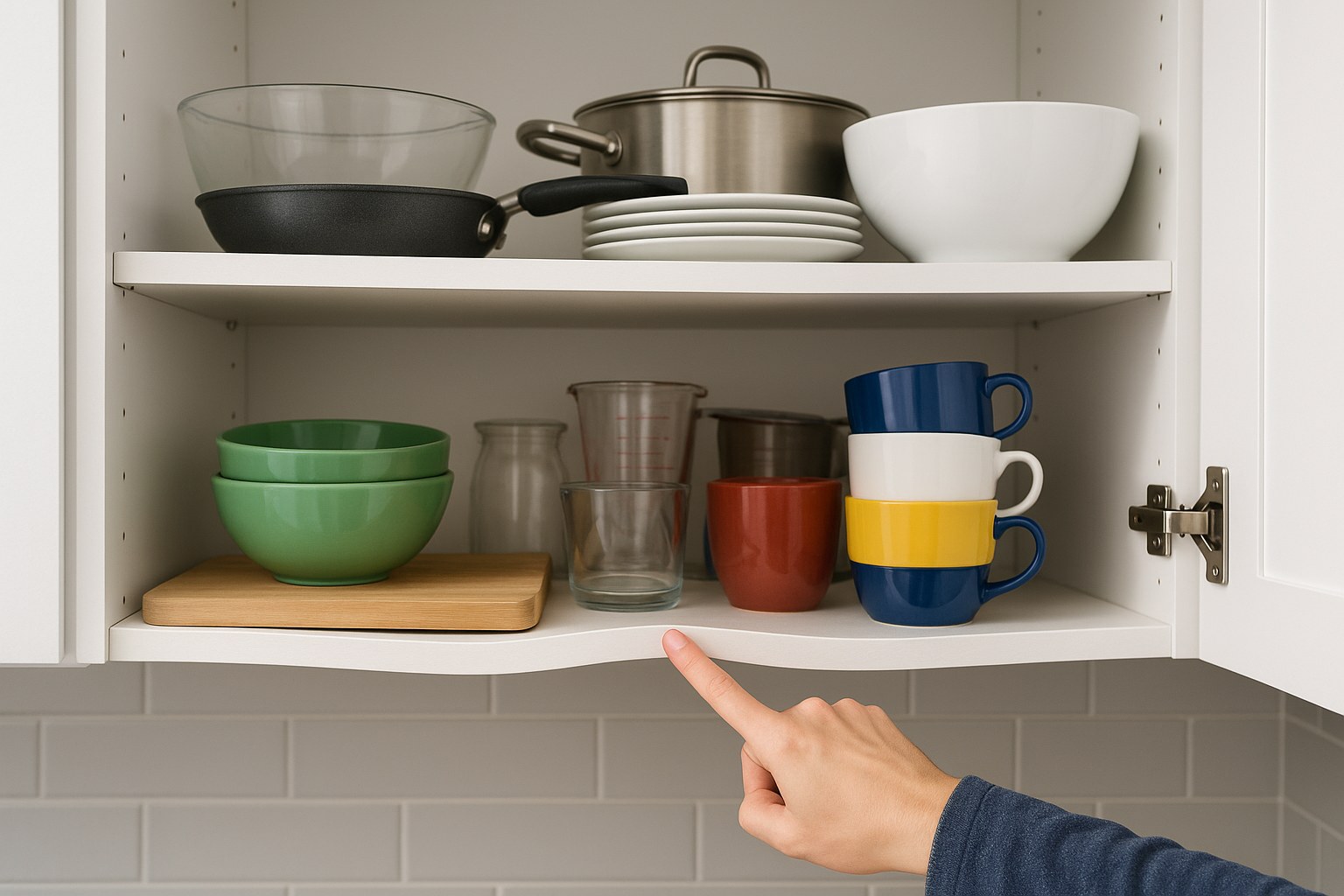
Empty the shelf first. If it springs back straight, it was overloaded, so lighten it and spread the weight. If it stays bowed, flip it so the curve faces up, and stiffen it with a solid wood strip along the front edge and a support under the middle of the span. A support at the side walls will not help, because the sag is in the middle.
Looking for more guidance? Take a look at our Repairs overview.
If the cabinet itself is leaning or coming off the wall, that is a different problem. Empty it and stop using it.
What Kind of Sag Is It?
| What you see | Likely cause | Fix |
|---|---|---|
| Loose shelf, curved, adjustable pins | Too long or too heavy a load | Flip, stiffen, or add a center support |
| Glass shelf bends | Too thin or too long | Lighten it, thicker tempered glass |
| Fixed shelf curved | Overload, weak material | Front strip, back cleat |
| Cabinet bottom sagging | Heavy items, or wet particleboard | Support from below, or replace |
| One end drops | Pin or hole worn out | New pin or a bushing |
| Shelf crumbles or swells | Water | Replace it, fix the leak |
| Whole cabinet slants or gaps at the wall | Fastening failure | Empty, call a pro |
Why Do Cabinet Shelves Sag in the First Place?
- Too long a span. Sag grows fast with length. A shelf that is a bit long holds much less than a short one. Doubling the span makes the same load per foot sag many times more.
- Too much weight in the middle. Stacked plates, cans, and cast iron are the usual ones.
- Weak material. Particleboard and MDF sag more than plywood or solid wood, and a thick shelf sags less than a thin one.
- Time, heat, and steam. A shelf that is loaded for years slowly takes a set. Steam from a dishwasher, kettle, or rice cooker speeds it up.
If you know the cabinet maker, check the rated shelf load and stay under it.
Step 1: Your Initial Inspection and Diagnosis
- Take everything off. Wait a few minutes and see whether it recovers.
- Lay a straight board across it and see how far the middle drops.
- Look at what it rests on. Pins at four corners leave the middle unsupported.
- Measure the span between the supports and the thickness of the shelf.
- Check if it is particleboard, MDF, plywood, or wood. Look at a raw edge. Crumbs mean particleboard, thin layers mean plywood.
- Look for damp or stains. Wet wood needs drying, not a brace.
- Look up and back. Gaps at the wall, cracked corners, or a bulging back mean the cabinet is in trouble, not just the shelf.
Quick Fixes
- Flip it. If it is loose and the same on both sides, turn it over so the curve points up. Load it lightly and it will settle.
- Move the heaviest items to the ends, the bottom shelf, or a lower cabinet.
- Replace the pins with ones that fit. They are usually 1/4 inch or 5 mm, so measure the hole. Metal pins hold better than plastic.
- Sleeve the worn holes. Push-in bushings give a pin something solid to sit in. You can also move the shelf up or down one row.
- Use a thicker shelf. A 3/4-inch plywood shelf is stiffer than thin particleboard. Finish the cut edges.
How to Fix a Sagging Wooden Shelf
Most of these take under an hour of work, plus time for the glue to dry.
Part A: Fixing an Adjustable Wooden Shelf
Tools and materials:
- Hardwood or plywood strip, 1-1/2 to 2 inches tall
- Wood glue, bar clamps, and sandpaper
- Drill, small bit, and finish screws
- Measuring tape
Glue a strip to the front edge:
- Cut a straight strip the length of the shelf. Taller is much stiffer than wider.
- Sand or scrape the shelf's front edge so glue can grip it. Glue does not stick well to plastic edge banding.
- Flip the shelf so it bows up, and clamp the strip to the front edge with the shelf pulled straight.
- Glue, add a few finish screws from below into predrilled holes, and let it dry as the label says.
- Check that the strip does not stop doors or shelves from closing.
This is the best all-round fix. A strip under the back edge helps too.
Or support the middle. Pick the one that keeps the cabinet usable:
- Divider. Cut a plywood panel to stand upright under the middle of the shelf, resting on the cabinet floor or a strong shelf below. Fasten it top and bottom with short screws so it cannot tip.
- Back cleat. Screw a straight wood strip along the back, right under the shelf, through the cabinet back and into wall studs. It holds up the whole back edge.
- Bracket. Put a shelf bracket at the middle of the back, screwed into a stud. A thin cabinet back will not hold it.
Check that no screw is long enough to poke through. Adding more pins to the side walls does not help, because the ends are not what is sagging. Before you screw into a wall behind a sink, stove, or outlet, think about the pipes and cables there and use a stud finder that warns of them.
Part B: Fixing a Fixed Wooden Shelf
You cannot flip a fixed shelf. Empty it, cut a prop to push the middle up until it is level, and glue and screw a strip along the front edge. Add a back cleat if you can reach studs. Leave the prop in place until the glue has cured. Go slowly. If lifting the shelf opens a gap anywhere in the cabinet, stop.
Cut a new shelf
If the shelf is swollen, cracked, or badly bowed, replace it. Measure the old one, or measure the inside width at the front and the back and take off about 1/8 inch. Use 3/4-inch plywood with the face grain running left to right, and seal or band every edge. Many lumber yards will cut it to size. Painted or melamine shelves in standard sizes can also come from the cabinet maker.
Fix a Sagging Cabinet Bottom
- Base cabinet, dry and firm: pull the toe kick and cut a block to fit between the floor and the underside of the cabinet, in the middle of the sag. Push the bottom up level and slide the block in.
- Wide base cabinet: use two or three blocks, or a length of 2x4 on edge running front to back.
- Wet, soft, or swollen: cut out and replace it with sealed plywood. See the water damage guide below.
- Particleboard floor sitting on the toe kick: lay a new 1/2-inch or 3/4-inch plywood panel over it. Measure the door clearance first.
- Upper cabinet bottom sagging: unload it and look at how the box is fixed to the wall. Do not add weight or a brace that hides a failing box.
How to Fix a Sagging Glass Shelf
- Take everything off and wear gloves. Check the edges and corners for chips or cracks. Replace any chipped or cracked shelf.
- Put back only light items, spread out, with the heavier ones near the ends.
- Check that all four supports match and have their rubber pads.
- If it still bends when nearly empty, it is too thin for the span.
Never drill or sand glass. Ask a glass shop for a thicker tempered shelf cut to the size, and use the number of supports it needs. Bring the width, depth, and span, and say what you want it to hold.
Keep Shelves Straight
- Keep heavy cookware and cans in base cabinets or near the ends.
- Break a long load into two shelves.
- Flip loose shelves once a year.
- Dry up leaks quickly, and do not run steam appliances under an upper cabinet.
What Does It Cost to Hire It Out?
Thumbtack data puts handyman cabinet work at $179 to $790 per job. HomeGuide lists replacing just the floor of a sink base cabinet at $150 to $200, and kitchen cabinet repairs overall at $120 to $600 on average.
When Is It Time to Call a Professional?
- The cabinet is tilted, or there is a gap at the wall or ceiling.
- Screws, hinges, or the back panel are pulling out.
- The shelf was built from a special material or has wiring.
- You need a new box or a custom shelf.
A carpenter or handyman will brace or rebuild the shelf, and for a loose cabinet will take the weight off, find the studs, and rehang it. Ask them to check the studs, the hanging rail, and the weight rating. If the cabinets are old particleboard, get a price to replace the shelves and, separately, the whole run. If you rent, report a leaning cabinet before you fix anything.
Common Questions
How much weight can a cabinet shelf hold? It depends on the span, thickness, and material, so there is no single number. Use the maker's rating. If you can see a bow with your everyday dishes on it, it is carrying too much for its length.
Will a sagging shelf break? Wood usually gives plenty of warning. Particleboard and glass can fail suddenly, so unload those first.