

Updated Nov 23, 2026
Ceiling Fan Installation: DIY or Hire an Electrician?
Find out if your ceiling box can hold a fan, when replacing an existing fan is reasonable DIY, and what an electrician should check and quote.
If you are replacing a fan that already hangs from a fan-rated box, and you are comfortable with a ladder and a helper, it can be a DIY job. If you are putting a fan where a light was, hire an electrician. The box and often the switch have to change, and that is the part that keeps the fan on the ceiling.
Looking for more guidance? Take a look at our Repairs overview.
Can Your Ceiling Hold It?
| What you have now | What it means |
|---|---|
| A fan that is solid, with a marked box | Like-for-like swap is possible |
| A light fixture | Assume the box is not rated. Electrician |
| A box you can't read, or that moves | Stop. Electrician |
| No box | New wiring. Electrician |
| Sloped or very high ceiling | Extra hardware and height. Ask first |
Hunter requires a fan to be secured to building structure or a box marked for fan support. It also says to turn off the circuit breakers for the box and the wall switch before servicing. If you can't lock the breaker off, put a warning tag on it.
Replacing a Fan on a Rated Box
Stop conditions: no ground wire, aluminum wire, scorched insulation, extra wires you can't explain, voltage on any wire, or a fan that needs a different box.
- Read the new fan's manual and check that it weighs no more than the box allows.
- Turn off the breaker and the wall switch. Try both. Tape a note over the breaker.
- Test your tester on a live outlet. Test each wire in the box. Test the live outlet again. Klein Tools says to do this before and after each use, and that a pen tester can miss voltage.
- Photograph the wires. Remove the blades, then the light kit, then the motor, with a helper holding the weight.
- Install the new bracket with the screws supplied for it. Do not use drywall screws.
- Hang the motor on the bracket's hook, if the manual has one. Join the wires as its diagram shows, with the ground first. If the wires do not match, stop.
- Seat the hanger ball, tighten the set screws, and lock the bracket as the manual says.
- Fit the blades last. An ENERGY STAR-hosted guide says never to attach blades before the motor is up, and that the downrod locking bolt must be tight or the fan can fall.
- Restore power. Watch on low for wobble, then each speed.
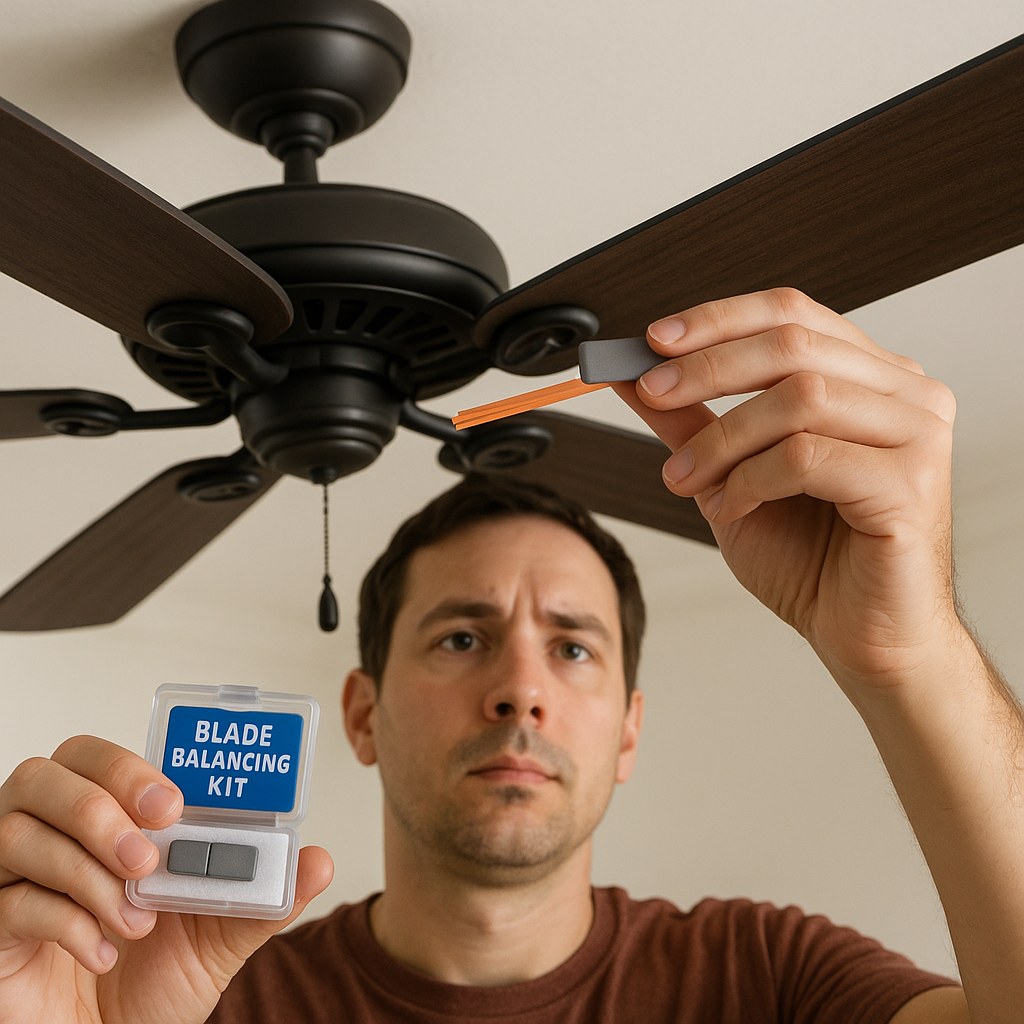
If it wobbles or hums, turn it off and tighten the blades, not the canopy wiring. See how to fix a wobbly fan.
Hiring It Out
Thumbtack data puts the national average for ceiling fan installation at $146 to $351, and most people pay around $225. That is for the work alone, since the fan is bought separately, and a new brace, a longer wire run, or ceiling repair all add to it.
Ask the electrician to price:
- A fan-rated box and brace, including ceiling repair.
- The switch or remote. A fan and light on separate controls may need another wire.
- The permit, if your city needs one.
- The old fixture's removal.
Ask to see the box mark after it is in. Get the model number of the fan-rated box in writing. It matters when you sell.
Choosing the Right Fan
Blades should be at least 7 feet from the floor and 30 inches from walls. Match the fan to the room, keep the original blades together, and buy light bulbs rated for the fan's vibration.