

Nov 23, 2026
How to Lower Your Water and Sewer Bill
Test for leaks with your meter, learn how sewer charges are set, pick the upgrades that pay off, and ask your utility for a bill adjustment.
To lower a water and sewer bill, test for a leak first, then find out how your sewer charge is calculated, then cut the use that costs you most. The leak test takes two hours and almost none of your attention. The sewer question takes one phone call, and it's where the surprise money often is.
Looking for more guidance? Take a look at our Finances overview.
Read the Bill First
| Line on the bill | What it means | What you can do |
|---|---|---|
| Fixed or base charge | Owed even if you use nothing | Confirm the meter size and customer class are right |
| Water volume | Gallons, or CCF. One CCF is 748 gallons | Compare with the same period last year |
| Tiers or blocks | Each block of water can cost more than the last | Cut the gallons in your top block first |
| Sewer volume | Often based on water coming in, because many homes have one meter | Ask about a winter average or a cap |
| Stormwater | A flat fee, or based on hard surface | Ask if credits exist |
| "Estimated" reading | Nobody read the meter | Ask for an actual reading |
The Environmental Protection Agency (EPA) puts average use at about 82 gallons per person per day, or roughly 10,000 gallons a month for a family of four. Dry climates and summer watering push it up. If your use rises and you aren't watering more, suspect a leak.
Find Your Starting Point
| What you see | Start here | Who handles it |
|---|---|---|
| The meter moves when nothing is on | Finding the leak | You for a toilet or faucet, a plumber for anything hidden |
| Same use, higher cost | A rate change or a new fee | Read the rate notice, then call the utility |
| Summer is far above winter | Sprinklers, hoses, the pool | You, or an irrigation company |
| Sewer costs more than water | The averaging rule | The utility |
| Use is steady but high | Toilets and showerheads | You, or a plumber |
| A reading that makes no sense | A reread or a meter test | The utility |
Test for a Leak, Step by Step
EPA's method is to read the meter before and after two hours of using no water. If it changes at all, you probably have a leak.
- Choose a time when nobody will run water. Pause the ice maker, softener, humidifier, and sprinklers.
- Take a photo of the meter, including the small dial or triangle that shows low flow.
- Wait two hours without flushing, rinsing, or running a load.
- Take a second photo and compare.
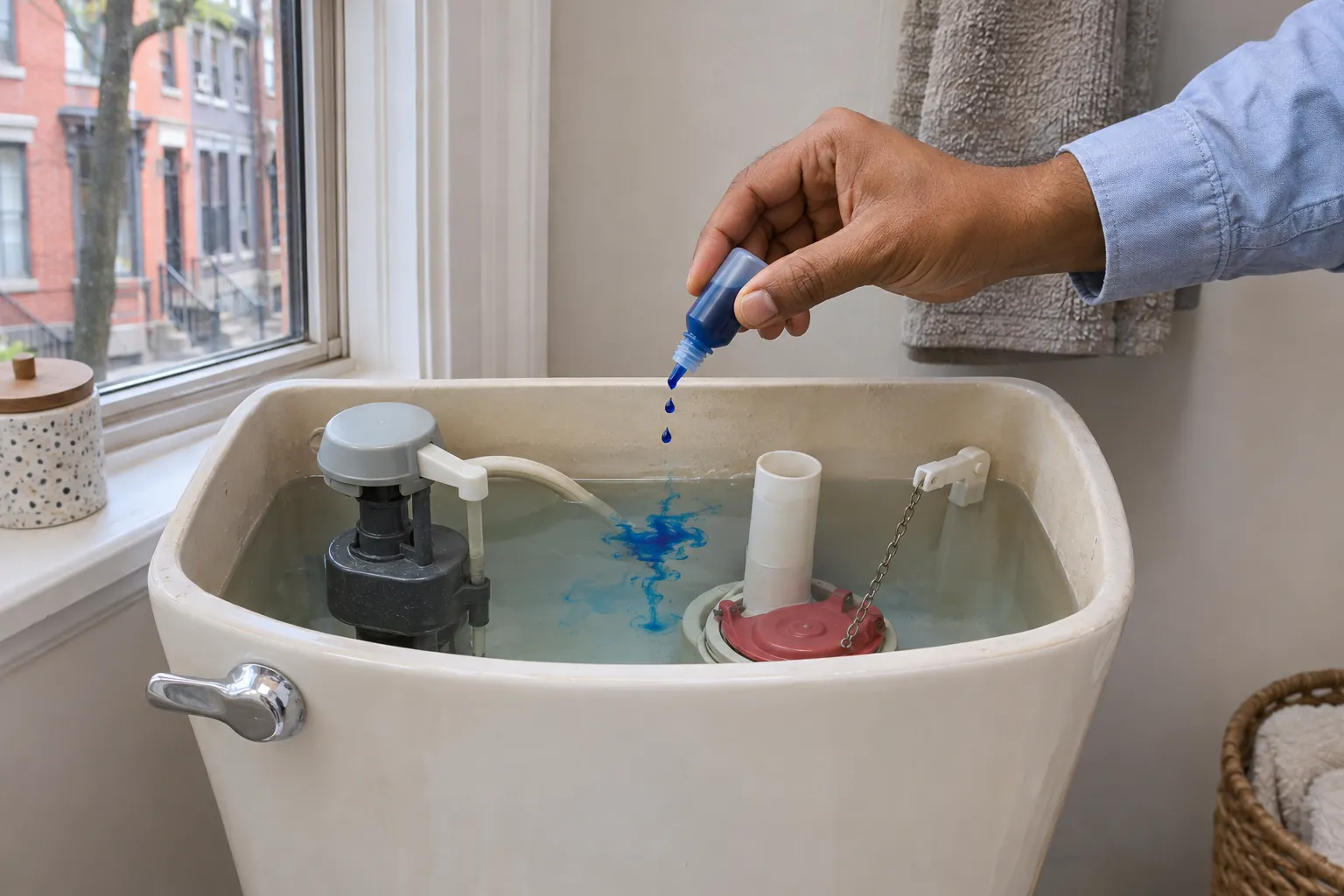
- If it moved, put a few drops of food coloring in each toilet tank and wait 10 minutes. Color in the bowl means that toilet leaks. Flush right after.
- If the toilets pass, close the main shutoff to the house and repeat the test, as long as the valve turns easily. If the meter still moves, the leak is likely between the meter and the house. If it stops, the leak is indoors.
A leaking toilet is a good first suspect, and the flapper is often the part to replace. Then check under sinks, around the water heater, at hose bibs, and for soggy patches above sprinkler lines.
EPA says nine percent of homes have leaks that waste 50 gallons or more a day, and estimates that fixing the easy ones can cut a water bill by about 10%. Yours could be more or less.
How Sewer Averaging Works
Most homes have no sewer meter, so the utility estimates. Many use a winter average, since that water mostly goes down drains instead of onto lawns. Portland, Oregon, bills sewer on your winter average or actual use, whichever is lower. Dallas does too, using bills from December through March.
That makes a winter leak expensive twice. It raises the water bill now, and Portland warns it can mean higher sewer charges all year.
Ask your utility:
- Is sewer based on actual use, a winter average, or a cap?
- Which bills set the average, and when does the new one start?
- Can the average be corrected after a leak or a pool fill?
- Is there a separate irrigation meter, and what would it cost?
If there's an averaging season, test for leaks just before it and save pool fills and car washing for afterward.
A Worked Example
These rates are invented. Water costs $4 per 1,000 gallons for the first 4,000, then $7 up to 8,000. Sewer costs $9 per 1,000 gallons, capped at the winter average. A household normally uses 5,000 gallons a month. A running toilet adds 3,000 a month from December through February, and then it's fixed. In five summer months they water the lawn and use more than 8,000 gallons.
| No leak | Winter leak | |
|---|---|---|
| Winter average | 5,000 gallons | 8,000 gallons |
| Water, three winter months | $69 | $132 |
| Sewer, three winter months | $135 | $216 |
| Sewer, five summer months | $225 | $360 |
| Total of these charges | $429 | $708 |
The other four months cost the same either way. The toilet cost $279, and $135 of that arrived after the repair. A corrected winter average would wipe that part out.
Upgrades Worth Comparing
| Upgrade | What EPA says | When it makes sense |
|---|---|---|
| Toilet | WaterSense models use 1.28 gallons a flush or less. Replacing older ones can cut toilet water by 20% to 60% | Old toilets, used a lot |
| Showerhead | No more than 2.0 gallons a minute, against a standard 2.5. Saves hot water too | Nearly always |
| Sprinkler controller | Can save up to 15,000 gallons a year over a clock timer | You have an automatic system and water-hungry summers |
Fixing and adjusting come before buying. A new flapper is far cheaper than a toilet, and a shorter sprinkler schedule is free. Ask about rebates before you shop.
Ask for a Bill Adjustment
Many utilities reduce a bill after a leak, and some don't. Portland considers one once the leak is fixed and you apply within 90 days of the high bill. South Bend, Indiana, offers payment arrangements but no leak adjustments for homes.
- Fix the leak, and keep the receipt and photos.
- Call and ask for the leak adjustment rule, the form, and the deadline.
- Give the dates you found and fixed it, where it was, and how it was repaired.
- Ask for the sewer charge and winter average to be reviewed too.
- Request a payment plan if you need one, so you don't go past due while you wait.
When to Call
- Your utility: a strange or estimated reading, water near the meter or in the street, or a bill you can't explain after the leak test.
- A plumber: the meter moves and you can't find why, there's a damp wall or warm floor, or the leak is underground.
- Right away: for a burst pipe, shut the main valve first. For sewage coming up a drain, stop using water, stay out of it, and call a plumber or your utility.
Our Recommendation
Test for a leak this week and again in early winter. Make the sewer call the same day. Then take the cheap fixes in order: flappers, sprinkler schedule, showerheads. Replace toilets when they're old or need repair anyway.
Casa can look at your water and sewer bills with the rest of your utilities and show you where you may be overpaying. Checking is free.
What to Have Ready
- A year of bills, with gallons or CCF
- Two meter photos, two hours apart
- Number of people at home, and anything that changed
- Repair receipts and dates
Mistakes to Avoid
- Comparing a winter bill with a summer one.
- Reading CCF as gallons.
- Paying for new fixtures before testing for leaks.
- Filling a pool while the average is being set.
- Missing the adjustment deadline.