

Updated Nov 23, 2026
How to Get Rid of Mold Under Your Carpet
Check mold under a carpet safely, decide what has to go, clean and dry the floor beneath it, and know when to call a mold or water damage company.
If you find mold under a carpet, plan to throw out the padding and the moldy carpet, clean and fully dry the floor underneath, and fix whatever got it wet. Mold grows through porous material, so scrubbing the carpet rarely works. You can do this yourself when the patch is smaller than about 10 square feet and the water was clean. Anything bigger, or any sewage or floodwater, is a job for a mold or water damage company.
Looking for more guidance? Take a look at our Maintenance overview.
What Causes Carpet Mold in the First Place?
It almost always comes down to moisture. Here are the usual suspects:
- High Humidity: Rooms with poor ventilation, like basements or bathrooms, can trap humid air, creating the perfect breeding ground for mold.
- Spills and Stains: If a liquid spill isn't cleaned and dried completely, the moisture can seep through the carpet fibers into the padding.
- Leaky Pipes or Roofs: A slow, hidden leak from plumbing in the walls or a compromised roof can saturate the subfloor and padding from below.
- Flooding: Even minor flooding can leave behind enough moisture to trigger a significant mold problem if not addressed immediately.
- Condensation: In cold climates, condensation can form on concrete subfloors, creating a layer of dampness right under your carpet.
Find and fix the source first. If you don't, the mold will come back.
Step 1: Your Initial Assessment and Safety Check
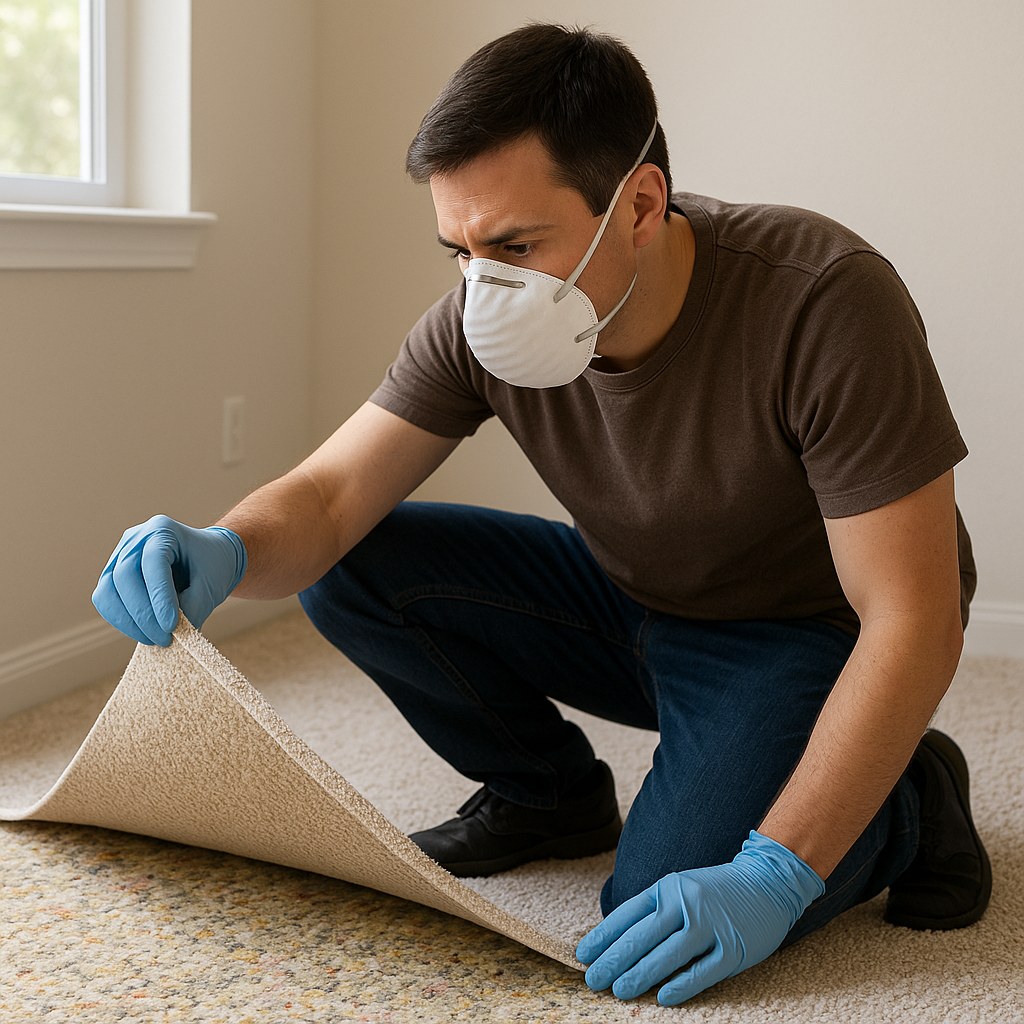
Protect yourself before you lift anything. People with asthma, allergies, a weakened immune system, or who are pregnant should stay out and let someone else do it.
Safety Gear:
- N95 Respirator: A cloth or paper mask won't filter spores.
- Rubber Gloves: Protect your hands from mold and cleaning products.
- Safety Goggles: Choose a pair without vent holes.
Turn off the heating and cooling so it doesn't spread dust, and keep children and pets out.
- Lift the Carpet: Find a corner near where you suspect the mold is. Grip the edge with pliers and pull it gently off the tack strip, which is full of sharp nails. Fold it back just far enough to see the backing and the padding.
- Inspect Closely: Look for the classic signs: dark, fuzzy growth, black or green spots, or discoloration. Check both the carpet backing and the top of the carpet padding.
- The Size-Up: Grab a tape measure. The Environmental Protection Agency (EPA) says you can usually handle an area less than about 10 square feet (roughly a 3-foot by 3-foot patch) yourself. If it's larger, fold the carpet back down and call a mold remediation company.
- Check the Surroundings: Look at the nearby baseboards and walls for any signs of water stains or mold growth. If the mold has spread beyond the floor, it's another sign you may need professional help.
- Test for Dampness: Press down on the padding and the exposed subfloor. Does it feel damp? A moisture meter from a hardware store gives a better reading.
- Ask Where the Water Came From: If it was sewage, a backed-up drain, or floodwater, stop. The EPA says to call someone experienced with contaminated water.
- Check What Is Underneath: Old tile, sheet flooring, or black adhesive under the carpet may contain asbestos in an older home. Don't scrape, sand, or pull it up. Have it tested first.
If the patch is small, the water was clean, and the mold hasn't reached the walls, you can carry on.
Step 2: Prepare the Room for Mold Removal
Set up the room so you don't spread spores to the rest of the house.
- Ventilate: Open any nearby windows. Place a box fan in the window, facing outward, to pull airborne spores out of the room. Do NOT point a fan directly at the moldy area, as this will just blow spores around the house.
- Clear the Area: Move all furniture out of the room. If anything is too heavy to move, cover it completely with thick plastic sheeting and tape it down.
- Isolate the Room: Close the door to the room. If you can, seal the door's edges with plastic sheeting and tape to further contain the workspace.
- Expose the Problem: Roll back the carpet and padding to fully expose all the moldy areas on the carpet, padding, and subfloor. This will help you decide the next step.
Step 3: To Clean or to Replace? Making the Call
The EPA says absorbent materials such as carpet may have to be thrown away if they become moldy, because the mold is hard or impossible to remove completely.
- Replace it if: You can see mold on the carpet backing or padding, it smells musty when dry, it's falling apart, or it stayed wet for more than about two days. Padding with mold always goes.
- Dry it and keep it if: It got wet with clean water in the last day or two, and there is no mold or smell.
Option A: How to Dry Carpet That Has No Mold Yet
- Pull up as much water as you can: Use a wet/dry vacuum plugged into a GFCI outlet, on a dry part of the floor.
- Take out the padding: It holds water like a sponge. Replace it rather than trying to dry it.
- Lift the carpet and move air under it: Prop the edge up and run fans and a dehumidifier. The EPA says to dry wet materials within 24 to 48 hours.
- Check before you lay it back: The carpet and the floor should be completely dry and smell of nothing. If you find mold, go to Option B.
Option B: How to Remove and Dispose of a Moldy Carpet Section
Mist the moldy area lightly with water and a drop of dish soap first, so dust doesn't fly. Keep fans off it while you cut.
- Mark Your Cut: Use a marker to draw a rectangle on the carpet that extends at least 12 inches beyond the visible mold on all sides. This ensures you remove any unseen growth.
- Cut It Out: Use a sharp utility knife, cutting away from your body, through the carpet and then the padding along the lines. Go only as deep as the padding so you don't score the floor.
- Bag It Securely: Tightly roll up the moldy section you just cut out. Immediately place it into a heavy-duty trash bag (6-mil contractor bags are great for this).
- Seal and Remove: Squeeze the air out of the bag and seal it tightly with duct tape. Carefully carry the bag outside for disposal according to your local regulations.
Step 4: Treat the Subfloor (Do Not Skip This Step!)
The floor under the carpet needs to be cleaned and dried before anything goes back.
For a Concrete Subfloor:
- Scrub: Use detergent and water, going about a foot beyond the moldy patch. You don't need bleach. If you use a mold cleaner, follow the label and don't mix it with anything.
- Rinse and Dry: Wipe with clean water, then run a fan and dehumidifier until the concrete is completely dry. It can take several days.
- Look for the source: If damp keeps coming up through the slab, carpet isn't the right floor for that spot. A sealer won't stop water coming from the ground. Start outside, with gutters and downspouts.
For a Wood Subfloor:
- Scrub: Use detergent and water with a stiff brush, along the grain. Use as little water as you can, since wet wood warps.
- Wipe and Dry: Wipe off the moisture, then run a fan and dehumidifier until the wood is totally dry.
- Press on it: If the wood is soft, stained through, or crumbling, stop and call a contractor. It may need to be replaced.
- Prime if you like: A stain-blocking primer can hide stains and lock in odor, but only on clean, dry wood. The EPA says not to paint over mold. Primer doesn't kill it.
Step 5: Finishing the Job
Once the floor is clean and fully dry, you can finish.
- If you dried the carpet: Lay new padding, then the carpet, and press the edge back onto the tack strip. A flooring installer can stretch it if it ripples.
- If you removed a section: Install a new piece of carpet padding of the same thickness. Then, lay a new, matching section of carpet. You may need seam tape to join the new piece to the old.
Vacuum the carpet with a HEPA vacuum, and keep a dehumidifier running for another day or two. Aim for indoor humidity below 60 percent.
What Does Professional Mold Removal Cost?
Thumbtack puts the national average for mold removal at $755 to $2,777. Widespread growth, wet subfloor or a moisture source you cannot find all push the price up.
When a DIY Fix Isn't Enough
Call a mold remediation or water damage company if:
- The mold covers more than 10 square feet.
- The mold comes back after you've cleaned it.
- The musty smell persists.
- The mold has spread to your HVAC system or inside walls.
- The water was sewage or floodwater.
- Anyone in the house is having symptoms. Talk to a doctor too.
Ask for a written scope: what they'll remove, how they'll contain the area, how they'll find and fix the moisture, and how they'll check that it's dry. Get a second quote for anything large. If the water came from a sudden leak, take photos and call your insurer before you throw things out.