

Updated Nov 23, 2026
Water Heater Leaking? What to Shut Off and Who to Call
Stop a water heater leak safely, find where the water is coming from, and learn why a dripping relief valve or leaking tank needs a plumber.
Turn off the heat if you can reach it dry, close the cold water valve above the heater, and call a plumber. A leaking tank can't be repaired. A leaking relief valve is a warning about pressure or temperature, so it isn't a part to swap on a Saturday.
Looking for more guidance? Take a look at our Repairs overview.
You can safely find out where the water comes from, put a cap on a dripping drain valve, and wipe up condensation. Leave the rest to a plumber.
If You Smell Gas or an Alarm Sounds
Leave first. Don't use a switch, a phone, or a flame, and don't stop to turn off the gas or water. Call your gas utility or 911 from a safe place. If a carbon monoxide alarm sounds, go outside and call 911.
Stop the Water
Don't step into water that may be touching wiring or an outlet.
- Turn off the heat, from a dry spot.
- Electric: switch off the water heater's breaker. Don't open the panels on the tank.
- Gas: turn the knob on the front of the heater to Off, if you can reach it and it turns by hand. Don't use a tool.
- Can't reach it dry? Leave it and call your electric or gas utility.
- Close the cold water valve on the pipe into the top of the heater. If it won't turn, close the home's main water valve.
- Open a hot tap at a sink to take the pressure off.
- Protect the floor with towels, a pan, or a wet vacuum plugged into a dry GFCI outlet.
- Take photos for the plumber and your insurer.
Don't drain the tank in a hurry. The water can scald, and an old drain valve may not close again. If water is spraying or rising fast, shut off the main and call an emergency plumber.
Know Which Heater You Have
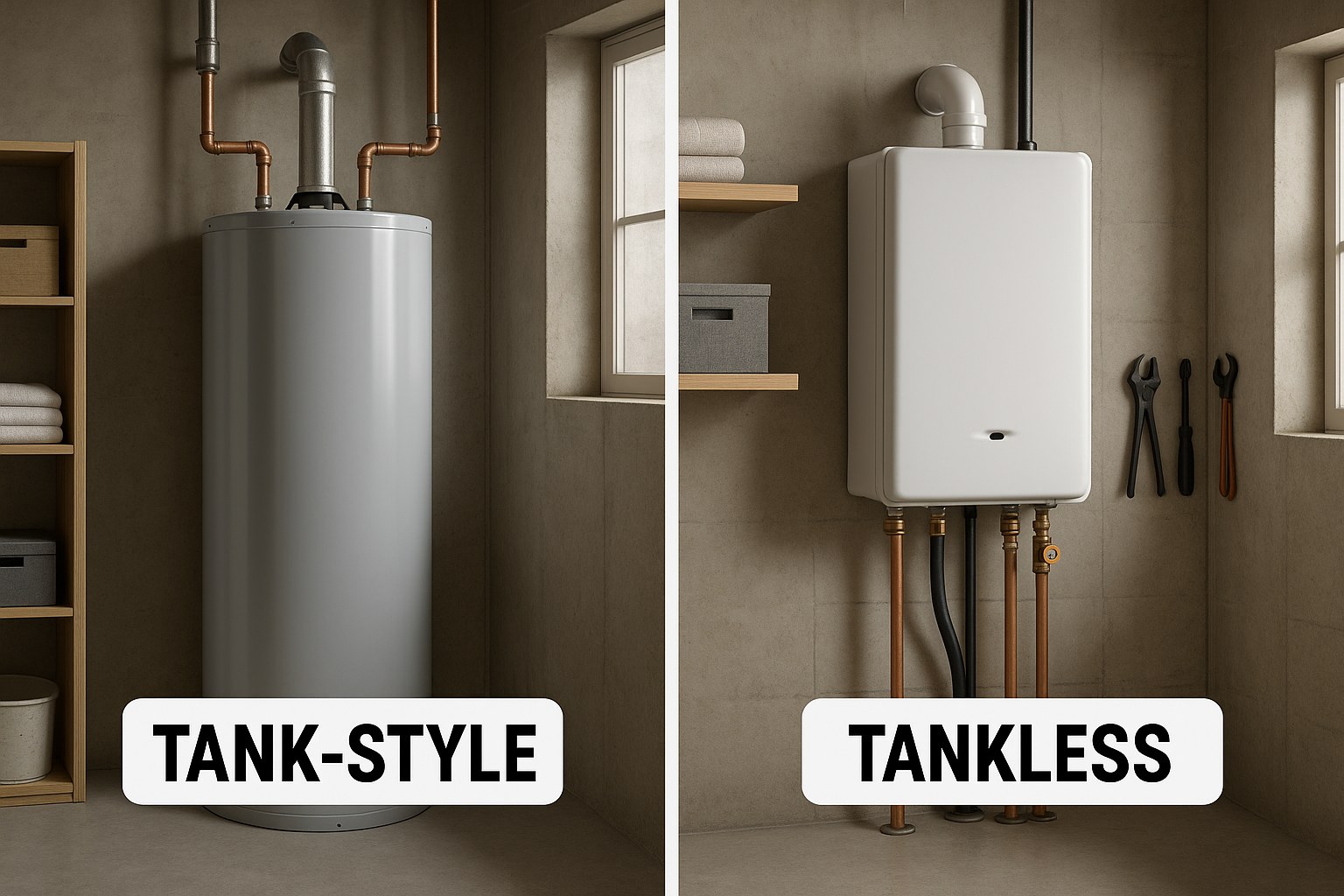
- Tank: a tall cylinder that stores hot water.
- Tankless: a box on the wall with no stored water.
Find the Source
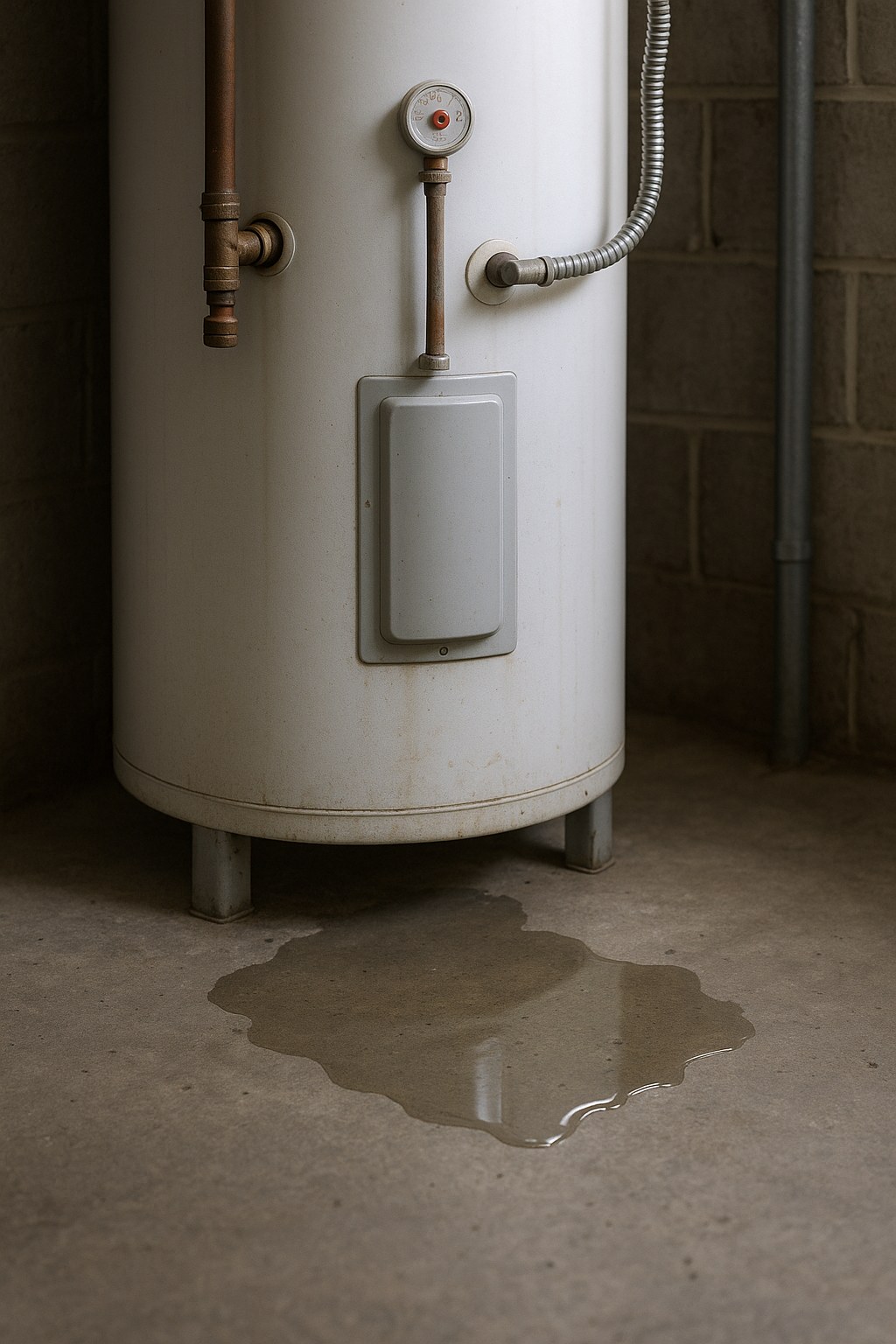
With the heat off, dry the top, the pipes, and the sides with a towel. Wait, then look with a flashlight for the first drop. Water runs down, so the puddle is rarely under the leak. Hot parts and discharge pipes can burn.
| Where the first drop forms | Likely cause | What to do |
|---|---|---|
| Beads all over the tank, soon after a lot of hot water use | Condensation | Dry it and watch |
| Pipe fittings on top | Loose or corroded connection | Leave it off. Plumber |
| Relief valve or its pipe | Too much pressure or heat, or a worn valve | Leave it off. Plumber |
| Drain valve at the bottom | Valve not closed, or worn | Close it by hand. Cap it. Plumber if it drips |
| Seam, side, bottom, or inside the burner area | Failed tank | Leave it off. Replacement |
| Vent pipe or draft hood | Exhaust problem or rain | Leave it off. Call now |
| Tankless, inside the case | Internal leak | Leave it off. Plumber |
| Nearby pipe, softener, or AC drain | Not the heater | Find that leak |
A. O. Smith says condensation is normal when a cold tank heats up and shouldn't be confused with a tank leak. If it doesn't stop once the tank is hot, treat it as a leak.
A Dripping Relief Valve
The temperature and pressure relief valve keeps the tank from exploding. A. O. Smith's manual says that if it drips, have a qualified person replace it, and not to plug or remove it. It also says the cause may be pressure that builds up in a closed plumbing system. A new valve alone won't fix that. Ask the plumber to check your water pressure and expansion tank.
A Dripping Drain Valve
Close the handle or screw snugly by hand. If it still drips, screw a hose cap onto the threads, hand tight. That is a short-term fix. Don't force a plastic valve.
A Fitting on Top
A quarter turn of a wrench can crack a corroded fitting or twist a gas line or vent connected to the same heater. Turn the heat and water off and let a plumber do it.
A Leaking Tank
Water from the tank itself means the steel inside has rusted through. It won't seal again, and it can get worse quickly. Leave it off and plan to replace it.
Gas Heaters: Extra Checks
Look, without touching. Soot, scorch marks, melted plastic rings on the pipes, or a vent pipe that has come apart can mean exhaust is spilling into the room. The Department of Energy's Building America guide says to call a plumber as soon as possible. Leave the heater off.
Never relight a gas heater that has been under water. A. O. Smith says it must be replaced.
Repair or Replace? What Each Costs
Check the date on the data plate. The Department of Energy says most storage heaters last 10 to 15 years, and tankless units can last more than 20. A worn valve on a young heater is worth fixing. A leak on an old one usually isn't. Our repair or replace calculator compares the yearly cost of each.
Thumbtack data puts water heater repair at $297 to $1,198 nationally, and replacing the heater at $748 to $2,138. In its breakdown, replacing a gas water heater runs $1,239 to $1,353 and an electric one $1,080 to $1,088.
Ask for a written price for both, and ask:
- Where exactly is it leaking, and can you show me?
- What is the water pressure, and do I need an expansion tank?
- Does the price include the permit, disposal, a drain pan, and venting or gas changes?
- Is the tank or part under warranty?
Call your insurer about water damage. Policies often cover sudden damage to the house but not the heater itself. Dry wet materials within 24 to 48 hours to prevent mold.