

Updated Nov 23, 2026
Missing Gutter Downspout: What to Do Now and How to Fix It
Protect your foundation today, tell a simple lower-section fix from a job overhead, and know what to ask before paying for a new downspout.
A missing downspout lets all the water from that part of the roof fall in one place beside your house. Today, steer the water away at ground level. Then look up. If only the lower section is gone, you may be able to replace it from the ground. If the outlet or upper elbow is missing, hire a gutter company, because that work happens overhead at the gutter.
Looking for more guidance? Take a look at our Repairs overview.
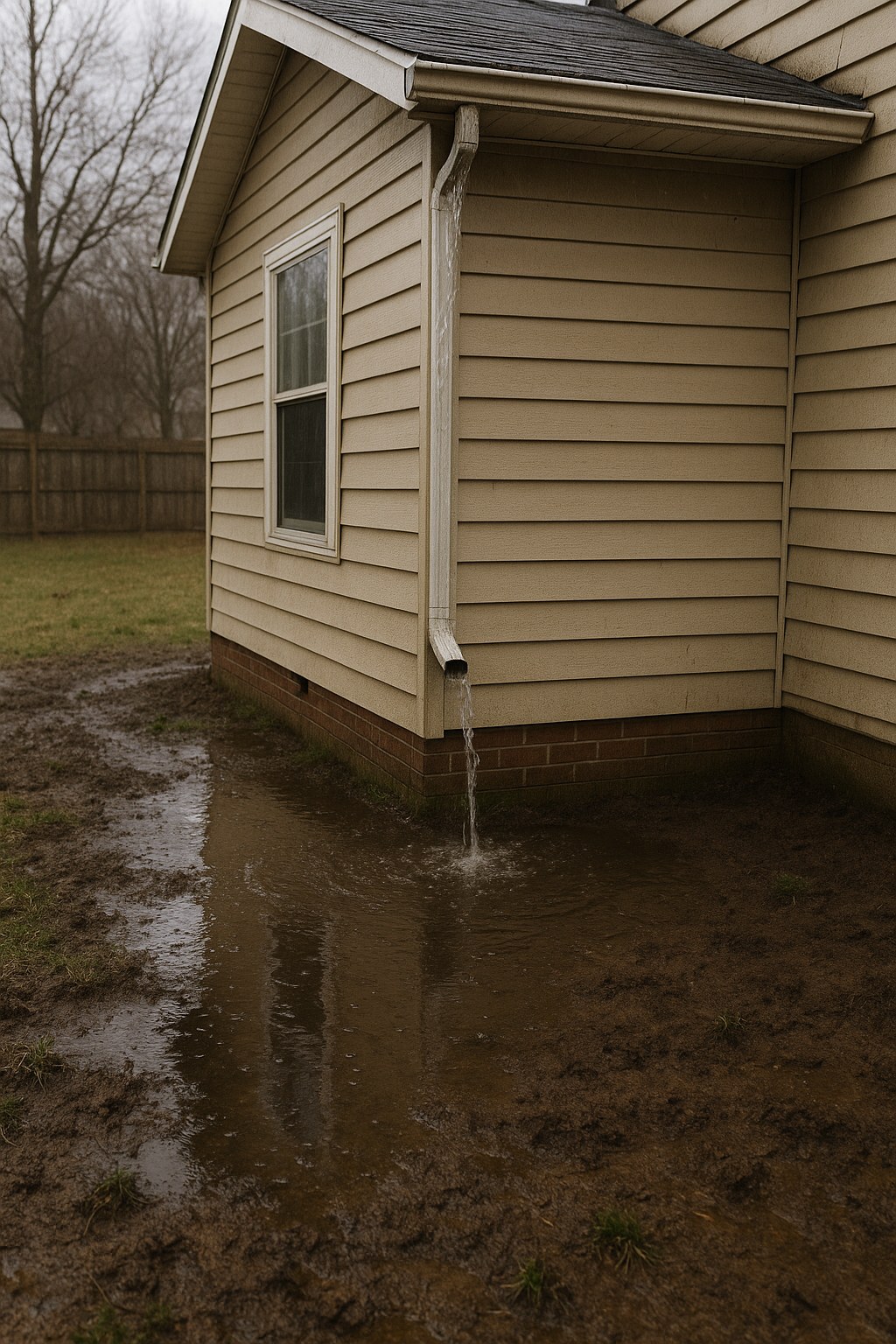
Why a Missing Downspout Is a Critical Fix
- Foundation damage. Soaked soil swells and presses on foundation walls, which can crack or shift them over time.
- Wet basement or crawl space. Water finds cracks and gaps, then leaves mold and ruined belongings behind.
- Siding and paint damage. Water running down the wall stains siding, peels paint, and rots the wood beneath.
- Erosion. A single heavy stream digs out mulch, soil, and plants.
A concentrated stream is the worst case. The University of Minnesota Extension says a downspout without an extender or splash block is worse than none, since it drops the roof's water in one spot. A gutter outlet with no downspout at all does the same thing from higher up.
Do This First
- Move anything valuable away from the wall inside, especially in a basement.
- During dry weather, lay a splash block, a slanted board, or a sheet of plastic under the opening so water runs away from the foundation.
- Keep people out from under any gutter or pipe that is hanging.
- Look for wet spots inside. If water is near outlets or a panel, stay out. The CDC says never to turn power on or off while standing in water.
- Look for the missing piece. Pipes that blow off often land in a hedge or a neighbor's yard, and a straight one can go back on.
Do not plug the outlet. The gutter would fill, overflow, and may pull off the house.
Step 1: Inspect Your Gutter System From the Ground
Use your phone's zoom or binoculars, and take photos for the store or the gutter company.
- Find what is left. Is there a short tube, the outlet, sticking down from the gutter? Is the upper elbow still on it?
- Look at the wall. Straps, screw holes, or a clean stripe show where the pipe ran.
- Look at the ground. A splash block, a buried pipe, or a plastic adapter shows where the water used to go.
- Find out why it came off. Bent straps suggest a bump from a car or ladder. Split seams suggest ice. A clog leaves a pipe packed with leaves. Bare screw holes with soft wood mean rot.
Seamless or Sectional?
- Seamless (continuous) gutters are one long piece with joints only at corners. A new outlet has to be cut with a special tool, so a missing outlet is a job for a gutter company.
- Sectional gutters show a joint every 10 feet or so. The outlet is a separate fitting that the installer can swap.
Identify the Material
- Aluminum: light, usually painted, and a magnet does not stick. The most common.
- Vinyl: plastic, dull sound when tapped, color all the way through.
- Steel: rigid, a magnet sticks, and it may show orange rust.
- Copper: brown or green, heavy, with soldered joints. It needs a specialist. Missing copper is sometimes stolen, so file a police report before you call your insurer.
What Kind of Repair Is It?
| What is missing | Can you do it? |
|---|---|
| Lower elbow or extension | Yes, from the ground |
| Lower pipe section you can reach from the ground | Yes, with a helper |
| Upper elbow at the gutter | Call a gutter company |
| Outlet in the gutter | Call a gutter company |
| Whole run on an upper story | Call a gutter company |
| Copper or steel system | Call a gutter company |
Replace a Lower Section
Tools and materials: matching pipe, an elbow, two straps, an extension or splash block, short zip screws, a drill with a hex driver bit, a hacksaw, a tape measure, a pencil, gloves, and eye protection.
- Measure the width, depth, and length of the missing piece. Match it to another downspout on the house. Rectangular pipe is usually 2 by 3 or 3 by 4 inches.
- Buy the same size and material. Add an elbow, two straps, and an extension.
- Work out the cut. Leave room for the elbow, so the opening ends just above the splash block or extension.
- Cut the new pipe on the ground or a workbench. File off the burrs. Wear gloves and eye protection.
- Slide the pieces so each upper piece fits inside the one below it. That keeps water in. The crimped, slightly narrower end always points down.
- Have a helper hold the pipe while you fasten the joint with short screws.
- Strap the pipe to the wall at points you can reach from the ground. Use fasteners suited to your siding. Stop if you would drill into old painted or cement siding.
- Run the extension at least 5 feet from the house, the distance in the Department of Energy's Building America guide.
- Test it with a hose at the lower joint, or wait for rain. Look for drips at the joints and puddles by the wall.
If the house was built before 1978, the paint may contain lead. The EPA describes lead-safe practices for do-it-yourself work. Do not drill cement shingle siding in an older home until you know it is not asbestos. The EPA says not to saw, sand, scrape, or drill material that may contain it.
What the Gutter Company Does Up High
If the outlet is sound, they slide an elbow over it, screw it on, add a second elbow to bring the pipe back to the wall, and drop the new pipe into place. Straps go near the top, near the bottom, and about every 6 feet between. Snowy areas often get one more.
If the outlet is torn, loose, or too short to hold screws, they fit a new one. In a seamless gutter that means cutting the opening clean, riveting or screwing in the new outlet, and sealing around it.
If the board behind the gutter is soft, they replace it first, because new screws will not hold in rot.
They should finish by running water through it. One downspout on a one-story house is usually done in an hour or two.
What Does a New Downspout Cost?
HomeGuide puts the average cost to replace or add one downspout at $30 to $75. A full set of four or five costs $220 to $625. Material changes it: aluminum is about $3 to $4 per foot installed, and copper is $14 to $34. If the gutter needs repair as well, Thumbtack lists $215 to $685.
What to Ask a Gutter Company
- Why did it come off? Was it loose straps, a clog, ice, or rotten wood?
- Is the gutter slope right for this outlet?
- How many downspouts does this roof need? Building America suggests one at least every 50 feet of gutter.
- Where will the water discharge?
- Does the price include the outlet, straps, extension, and sealing?
A single downspout is a small job, so ask whether cleaning the gutter or checking the other straps can be done in the same visit.
If the gutter is also rusted through, split at several seams, or sagging, price a full replacement before you pay for a new downspout on an old system.
If Siding or Soil Is Already Damaged
Take photos before you repair anything. If a storm caused it, ask your insurer what to document. The Texas Department of Insurance advises keeping receipts for temporary repairs and waiting on permanent ones until the adjuster has seen the damage.
Once water is under control, refill washed-out soil so the ground falls away from the wall.
Keep the Next One From Falling
- Check straps and screws each spring, as far up as you can reach.
- Clear the gutter before winter. A pipe full of wet leaves freezes, swells, and splits.
- Put a short guard post or planter where cars and mowers bump the pipe.
- In a rental or condo, report a loose strap in writing before it lets go.
Common Questions
Can I use a rain chain instead? Yes, in a mild climate with modest rain. A rain chain slows water but splashes, so it needs a basin or drain that carries water at least as far from the house as a downspout would.
Can I leave the gutter without a downspout? Only if the opening drains somewhere that already slopes well away, and even then it erodes the soil. For anything beyond a few days, put the pipe back.