

Nov 24, 2026
How to Use AI to Diagnose a Home Problem
What to photograph, what to say, and what to ask so AI can narrow down a home problem, plus a prompt to copy, four examples, and what AI gets wrong.
To get a useful diagnosis from AI, send three photos, say what changed and when, and give the age of the thing that's acting up. Then ask for the likely causes in order, the one safe check that tells them apart, and the point where you should stop. Treat the answer as a short list to narrow down, not a verdict.
Looking for more guidance? Take a look at our Repairs overview.
Done well, this takes ten minutes and can save you a service call. Done badly, it gives you a confident guess about somebody else's house.
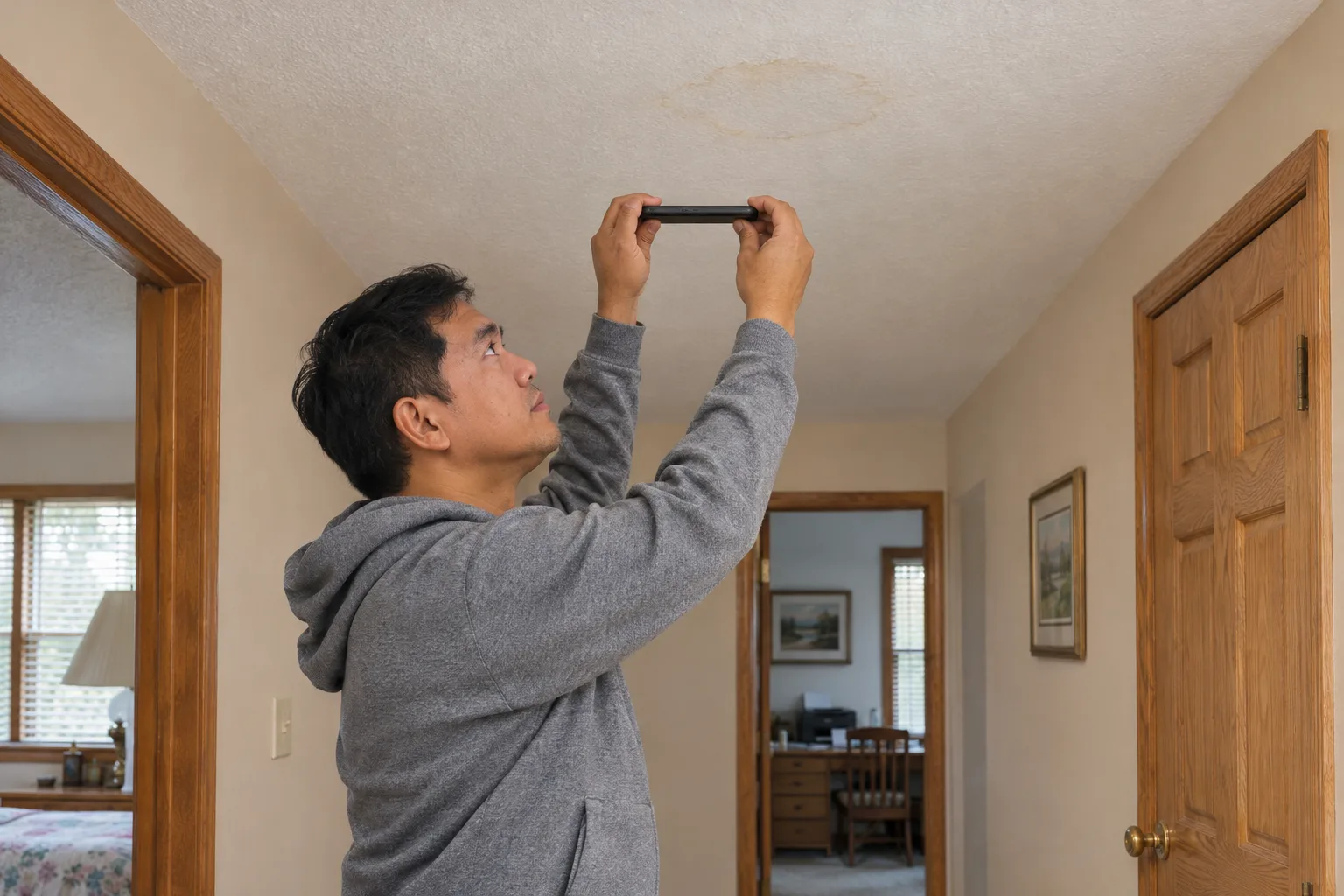
What AI Can and Can't See
| AI is good at | AI can't do |
|---|---|
| Naming a part, pest, stain, or error code | Smell gas, feel heat, or hear what you hear |
| Listing likely causes from symptoms | Measure voltage, pressure, or moisture |
| Telling urgent from annoying | See behind a wall or under a floor |
| Explaining what a pro will test | Know your local code or permit rules for certain |
| Turning a vague worry into a question | Stand behind the work |
People are already doing this. In a 2025 Guardian Service survey, more than 2 in 5 homeowners had asked AI for help with a repair or maintenance job. Of those who followed some or all of the advice, 44% said they saved money. They were also choosy: 42% didn't trust it with electrical questions and 38% didn't trust it with foundations.
Step 1: Take the Right Photos
| Photo | Why it helps |
|---|---|
| The whole area from several feet back | Shows what's above, beside, and below the problem |
| Close up, in focus, with a coin or tape measure | Gives the size, so you can tell whether it's growing |
| The label with the model and serial number | Gets you the right parts and the age |
| The other side of the wall, ceiling, or pipe | Often shows the real source |
| The display with any error code | Codes are the fastest diagnosis there is |
Use daylight or a lamp from the side, which makes bumps and damp spots easier to see. Take a second set a day or two later for anything that might be spreading. For a noise, write down what it sounds like, when it happens, and what stops it. AI may not read a video or its sound correctly.
Keep panels, covers, and walls closed. If the only good photo needs something opened up, that's a pro's photo to take.
Step 2: Tell It What It Can't See
Six details do most of the work:
- What you see, hear, or smell, in plain words.
- When it started, and whether it's steady, worse, or comes and goes.
- What changed around then: weather, a repair, a new appliance, houseguests.
- The age of the system and the house.
- What you've already tried, and what happened.
- Your limits: tools, ladders, budget, and how handy you are.
A Prompt to Copy
Fill in the blanks and send it with your photos.
Here are photos of a problem in my home. I notice ___. It started ___ and it's getting better / worse / staying the same. Around then, ___ changed. The house was built in ___. The equipment is about ___ years old, model ___. I've already tried ___.
Before you answer, ask me up to three questions that would change your answer. Then tell me:
- Is this urgent today, this week, or can it wait?
- What are the three likeliest causes, in order, and how sure are you of each?
- What's one safe check, without opening anything, that tells them apart?
- Where should I stop and call someone, and which trade?
- What does a visit usually cost, and what should they test?
- What are you assuming about my house?
Step 3: Push Back Once
The first answer is usually too broad. One of these will sharpen it:
- "What would you expect to see if the first cause were wrong?"
- "Which of these gets expensive if I wait a month?"
- "You can't see behind this wall. What are you guessing?"
- "What's the cheapest fix that could be true, and how would I rule it out?"
- "Does this change if the house was built before 1978?"
Ask the same question again in a new chat. If the top cause changes, you need a check or a person, not another opinion.
Four Examples
Brown ring on a bathroom ceiling. You send the stain, the room above, and a note that it grows after showers. A good answer says the tub drain or overflow is likelier than the roof, because the roof doesn't know when you shower. The check: run water straight down the drain for five minutes, look, then run the shower against the wall. If only the second one drips, it's the tile or overflow, not the pipe. Stop before you cut the ceiling.
AC runs but the house stays warm. You send the thermostat, the filter, and the outdoor unit. A good answer starts with the filter, then asks whether there's ice on the copper line. If there is, turn cooling off and let it thaw. Anything after that involves refrigerant or wiring, and that's a technician. Bad airflow in one room is a different problem.
Dishwasher won't drain. You mention the garbage disposal was replaced last week. That's the whole answer: a new disposal often still has a plug in the dishwasher port. Without that detail, AI sends you to the pump. More causes.
Toilet runs every half hour. You send the open tank. A good answer names the flapper, then gives the test: a few drops of food coloring in the tank and ten minutes without flushing. Color in the bowl means the flapper leaks. Fix a running toilet.
What AI Gets Wrong
- Look-alikes. Efflorescence looks like mold, and condensation looks like a leak.
- Materials. You generally can't tell asbestos by looking, and neither can AI. Lead paint needs a test too.
- The average house. It assumes copper pipes, drywall, and a furnace in the basement unless you say otherwise.
- Prices. They can be old, national, or for a smaller job than yours.
- Model numbers. One wrong character gets you the wrong part. Type it in as well as photographing it.
- Confidence. It sounds equally sure when it's right and wrong.
- Missing steps. When home repair company HomeServe compared AI answers to nine common questions, it found ChatGPT lacked nuance in troubleshooting.
Don't Use AI for These
Call a qualified person for gas, anything inside an electrical panel, warm or buzzing outlets, refrigerant, structural cracks that are growing, garage door springs, the main sewer line, and anything on a roof. AI can still help you describe it and work out who to call.
Turn the Answer Into a Decision
| If the answer says | Do this |
|---|---|
| Urgent, or it's near water, gas, or wiring | Stop and call |
| One likely cause, safe check, cheap part | Do the check, then the fix |
| Two or three causes that cost very different amounts | Pay for a diagnosis before any repair |
| Not urgent, not changing | Photograph it, date it, and look again in a month |
Our guide to fix it, wait, DIY, or hire covers the choice in more detail.
Hiring? Use what you learned to describe symptoms, not a diagnosis. "It drips only after showers, and here are the photos" gets you a better visit than "I need a new drain." Ask what they'll test, what the visit costs, and whether that fee comes off the repair.
Before You Upload
Crop out faces, mail, account numbers, and anything on the fridge. Photos can carry location data, so a screenshot of the photo is a simple way to strip it. Check whether the app keeps your images.
How Casa Does It
You can do all of this with a general assistant, but you start over every time. Casa already knows your home. Send a photo or describe the problem in the iPhone or Android app, and we ask the questions that change the answer, tell you whether it's a job for you, a pro, or nobody right now, and explain why. If you need someone, we can find local pros, contact the ones you choose, and gather times and estimates. Next time, we remember what it was. More on AI home repair.
FAQ
Can ChatGPT diagnose a home repair from a photo? It can often narrow the cause to two or three and tell you what to check. It can't test or open anything, so some answers need a person.
Is there an app that diagnoses home problems from a photo? Yes. Casa does, for free, on iPhone and Android, and it can line up a pro if you need one.
How accurate is AI at home repair? It depends on what you give it. One blurry photo gets a guess. Three photos, the age, and what changed usually get a short, useful list.
Can AI diagnose a noise? Sometimes, from a good description of when it happens and what stops it. Recordings are less reliable.
Should I tell my contractor what AI said? Share the photos and the pattern you noticed. Let them reach their own diagnosis, then ask how it compares.